About Dissosteira carolina (Linnaeus, 1758)
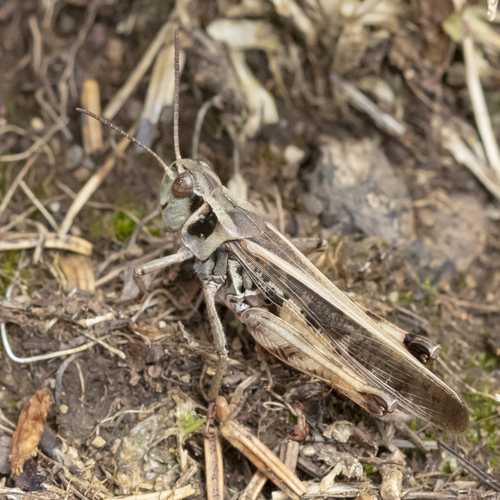
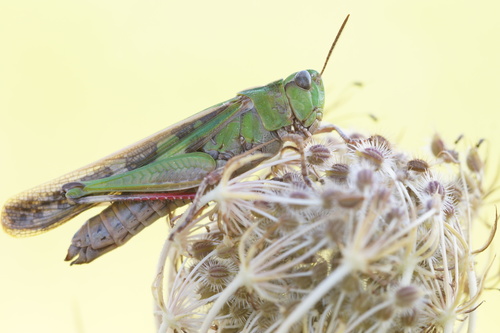
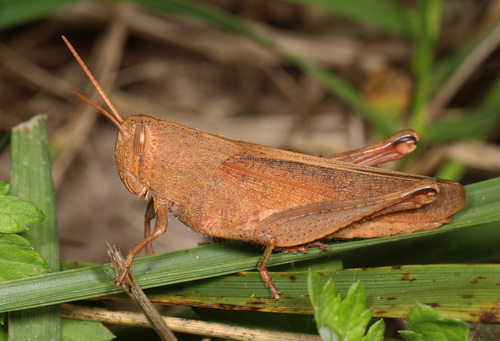
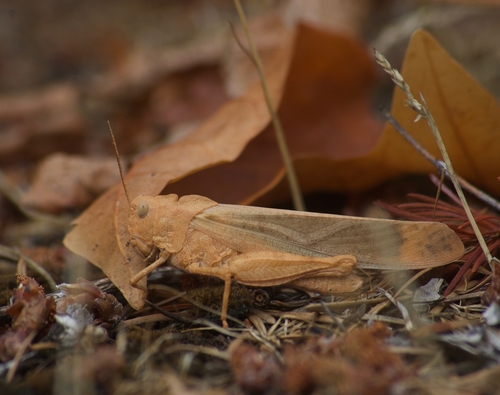
Dissosteira carolina individuals range in length from 32 mm to over 58 mm. Their large size, colorful wings, and habit of flying over dirt roads and other bare ground make them easy to spot. When spread, the wings of males measure 75 mm across, while female wingspans range from 80 mm to 102 mm. Their leathery forewings (tegmina) are colored light brown, tan, or gray, which provides camouflage against the dirt where they bask or hide. The inner flight wings are brownish-black with yellow margins, and have a ridge running down their back. When this grasshopper takes off to escape predators, it reveals its black-and-yellow hindwings extremely quickly. This shifts the grasshopper’s visible appearance from 100% camouflaged brown to more than 50% contrasting black-and-yellow, and roughly doubles its visible size in under 9 milliseconds. When landing, the reverse transition happens in less than 15 milliseconds. These rapid transitions can make the grasshopper seem to appear and disappear instantly to human observers. During flight, the hindwings switch between pauses and active wing-beating around six times per second, and during active beating, the wings beat more than 30 times per second. This creates an unstable, confusing visual image. Because of their large size and slow, bobbing flight pattern, they are often mistaken for butterflies, particularly the mourning cloak Nymphalis antiopa. Individual body color can vary across a range of shades, including golden tan, gray, dark brown, and greenish. Dissosteira carolina is native to North America. Its range covers southern Canada from British Columbia to the Atlantic Coast, and the United States from the east Coast south to Florida and west to Idaho.