About Disphyma papillatum Chinnock
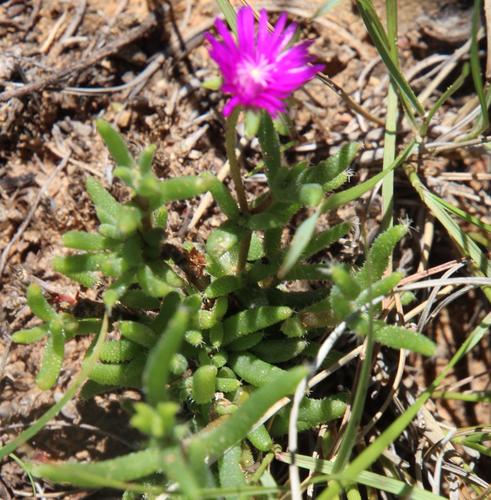
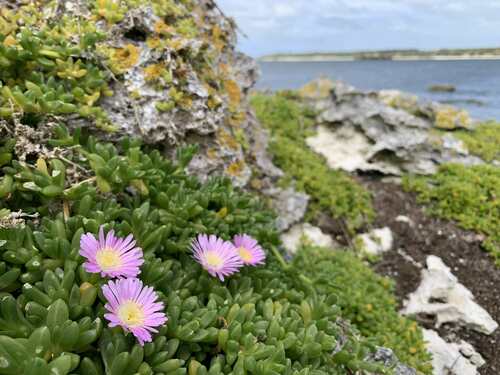
Disphyma papillatum Chinnock is a succulent, prostrate herb. It has pimply, two-angled trailing stems that root at their nodes, reaching up to 50 cm (20 in) in length, with most internodes measuring 20–30 mm (0.79–1.18 in) long.
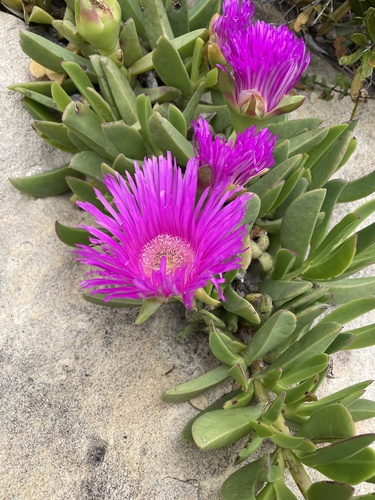
Leaves are arranged in opposite pairs, they clasp the stem and their bases are joined together. Each leaf is triangular in cross-section, typically 10–15 mm (0.39–0.59 in) long and 5–6 mm (0.20–0.24 in) wide, tapering toward the tip.
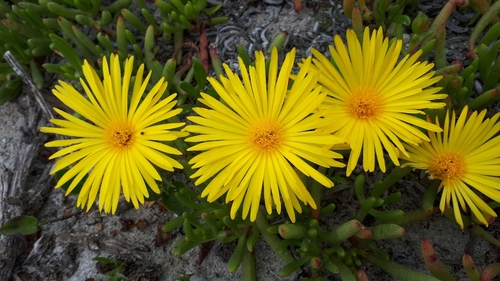
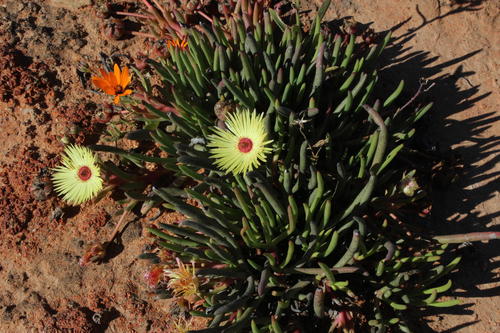
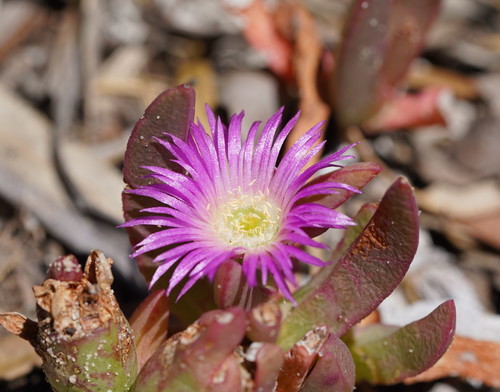
The flowers are superficially daisy-like, with a diameter of 20–40 mm (0.79–1.57 in). They grow on a pimply pedicel 20–30 mm (0.79–1.18 in) long, with five sepals at the base. Petals come in white, pink, dark blue or purple, arranged in three to five rows; each individual petal is 10–30 mm (0.39–1.18 in) long and 1.5–2 mm (0.059–0.079 in) wide. There are many stamens with yellow anthers, and five or six styles. Flowering takes place from November to January. The unopened fruit is a capsule 5–12 mm (0.20–0.47 in) in diameter.
This species is similar to Disphyma crassifolium, but differs in having pimply rather than smooth stems, and flattened two-angled rather than cylindrical stems. It is endemic to the Chatham Islands of New Zealand, where it occurs on the main Chatham Island, as well as Rangiuaria, Rangatira, Mangere Island, Little Mangere Island, Moturoa and Castle Island.