About Disphyma australe (Aiton) J.M.Black
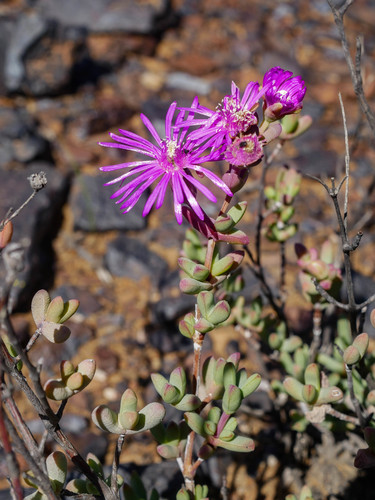
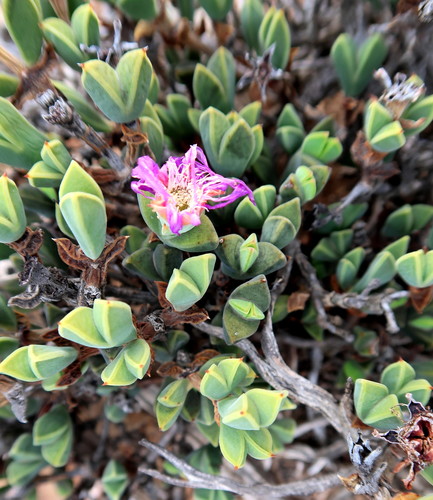
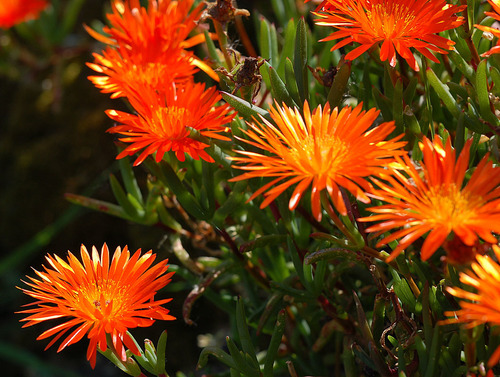
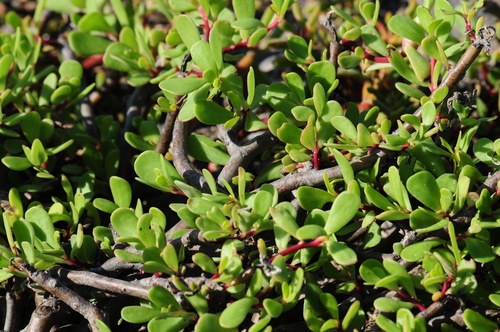
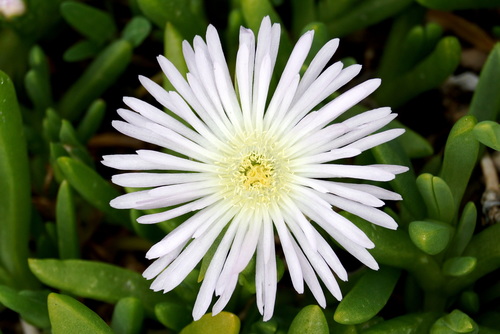
Disphyma australe, commonly called the New Zealand ice plant, is a succulent herb with a trailing or prostrate growth habit, meaning its branches usually spread along the ground. Its stems are stout, around five millimeters in diameter, and can grow to more than one meter in length; older branches in particular are typically semi-woody. Disphyma australe produces triangular, fleshy leaves that are usually 2–4 cm long and approximately 0.4–0.6 cm wide. Leaf tips range from pointed (acute) to rounded (obtuse), their bases are connate, and leaves are arranged opposite one another on the stem. A key distinguishing feature between Disphyma australe and its close relative Disphyma papillatum is that Disphyma australe has a smooth leaf surface, while Disphyma papillatum has a rough leaf surface. Another identifying trait is its prominent white or pink flowers, which measure 2–4 cm in diameter. Each flower grows at the end of a 1–4 cm peduncle, and has many 1–3 cm petals arranged in 3–5 rows. The succulent calyx is made up of five lobes, two of which are noticeably larger. The plant's reproductive organs include female 5–8-celled carpels that hold 5–8 styles and usually 6–8 stigmas, plus numerous male stamens 4–6 mm long, with filaments that are hairy at their base. The fruits of Disphyma australe are fleshy, vase-shaped capsules with parallel slits that allow the fruit to open, plus a flat end and wings. Each capsule encloses brown, wrinkled seeds that are oblong or egg-shaped, 0.9–1.2 mm long, compressed, with a slanted or wedge-shaped notched base and a rounded tip. There are two recognized subspecies of Disphyma australe: Disphyma australe subsp. australe and Disphyma australe subsp. stricticaule, which differ only slightly in a small number of traits. Disphyma australe subsp. australe has papillose sepal keels, and placental tubercles may be present, while Disphyma australe subsp. stricticaule has smooth sepal keels and lacks placental tubercles entirely. Disphyma australe is endemic to New Zealand, meaning it occurs naturally only in this region. It now also grows on a small number of Australian islands, including Tasmania, Norfolk Island, and Lord Howe Island. The two subspecies occupy different areas of New Zealand. Disphyma australe subsp. stricticaule is found only on the Kermadec Islands, while Disphyma australe subsp. australe grows across coastal areas of both the North and South Islands, and also occurs on smaller New Zealand islands including Stewart Island, the Chatham Islands, and the Solander Islands. D. australe subsp. australe also coexists with D. australe subsp. stricticaule on the Kermadec Islands. Disphyma australe is rarely found inland, but is very common in coastal areas. It especially prefers rocky shores, and both subspecies grow on cliff faces, rocks, and gravel and cobble beaches. It can also grow in other types of coastal habitat, including salt meadows and estuaries, and is occasionally found at the back of sandy beaches. It also grows near seabird nesting grounds, such as around petrel burrows, because unlike many other plants it can tolerate high concentrations of bird droppings. Disphyma australe is a perennial plant that can reproduce either by seed, or from detached plant parts that can re-root and grow in new locations. Flowers can appear throughout the year, but most blooming occurs from spring to summer. The flowers can track the movement of the sun, and as the former scientific name mesembryanthemum notes, they are typically open at midday. Fruiting most often happens between December and January, though fruits can also be found from September to April. As is typical for members of the Aizoaceae family, Disphyma australe seeds are held in capsules that stay closed during dry weather and open under wet or moist conditions, particularly after heavy rain. This trait is called hygrochasy, and it developed because the seeds germinate best on wet ground. This opening mechanism remains functional even after the plant has died. Seeds are dispersed to more distant locations via wind, water, or animals that eat the plant's fruits. Disphyma australe has a variety of uses. It is grown as a garden plant, and in the past it was primarily used as food and for medicine. Māori used the juice of its leaves to treat medical conditions including boils, abscesses, and itch. Recent research suggests Disphyma australe may have an antibacterial effect. European settlers ate the bland-tasting fleshy capsules of this species, and pickled its leaves.