About Diselma archeri Hook.f.
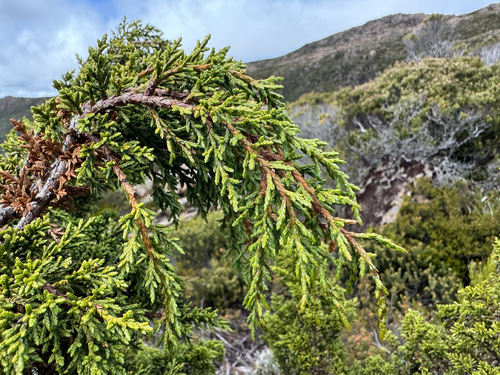
Diselma archeri Hook.f., commonly called dwarf pine or Cheshunt pine, is the only species in the genus Diselma, belonging to the plant family Cupressaceae. This species is endemic to alpine regions of southwest Tasmania, the Tasmanian Central Highlands, western coast ranges, and the area around Lake St. Clair. The monotypic genus Diselma is restricted to high-altitude rainforest and moist alpine heathland, and its distribution very closely matches that of two other endemic Tasmanian conifers: Microcachrys tetragona and Pherosphaera hookeriana. D. archeri is endemic exclusively to Tasmania, found only in high-rainfall alpine and subalpine areas of the state's South West and Central Plateau. Its altitudinal range spans approximately 580 to 1400 metres above sea level. Like many Tasmanian conifers, D. archeri is highly sensitive to fire, and only grows in fire-free areas of alpine coniferous heath and montane rainforest. In closed high-altitude rainforest, this species can grow as a small tree reaching 3 to 4 metres tall. Some ecologists classify Diselma as one of seven genera that can be used as indicators of rainforest in Tasmania. In more open coniferous heathland, Dwarf Pine grows in a more prostrate form, only reaching around 1 to 2 metres in height. D. archeri is a compact, often prostrate shrub that commonly grows 1–4 metres tall, though it has been recorded reaching greater heights in subalpine rainforest zones. Its foliage is grey-green, with branchlets that curve downward at their tips. Its branches are short, ridged, and very numerous. Foliage on branchlets appears square in cross-section. The plant's scale-like leaves measure 2–3 mm long, overlap, are arranged in opposite decussate pairs, and lie pressed closely against the stem. This square leaf arrangement is similar to that of Microcachrys tetragona (creeping pine, in the family Podocarpaceae), and the two species are easily confused. However, M. tetragona matches its common name by growing low to the ground, spreading out, and only producing occasional erect branches. Another species easily confused with Diselma is Pherosphaera hookeriana, previously known as Microstrobos niphophilus, which also belongs to Podocarpaceae. Both this species and D. archeri share similar growth habits and distributions, but D. archeri's arrangement of leaves in opposite pairs distinguishes it from P. hookeriana. The bark of D. archeri is rough and scaly, and often weathers to reveal reddish-brown inner bark. As a gymnosperm, it does not produce flowers. Instead, seed development occurs on the surface of modified scale-like leaves that form cones. D. archeri is a dioecious shrub, meaning male and female cones grow on separate individual plants. Both types of cone are very small, measuring 3–4 mm, and form at the tips of branches. Female cones are made up of two pairs of opposite cone scales, and only the upper pair of scales is fertile. When mature, the plant produces up to four small winged seeds that are dispersed by wind. D. archeri seedlings are uncommon, because the species often re-sprouts from roots and trunks buried in peat soils.