About Discosura conversii (Bourcier & Mulsant, 1846)
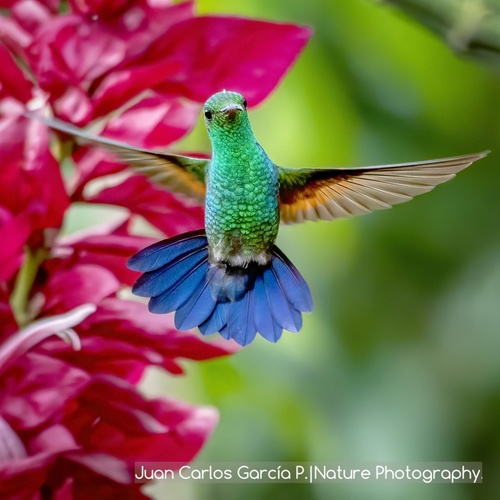
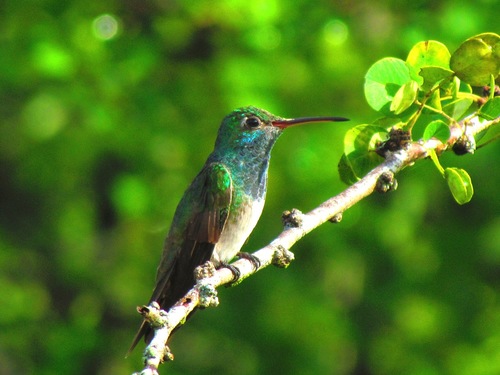
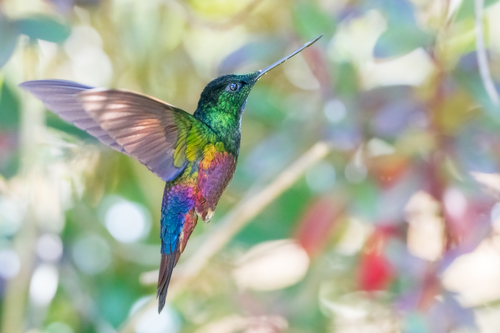
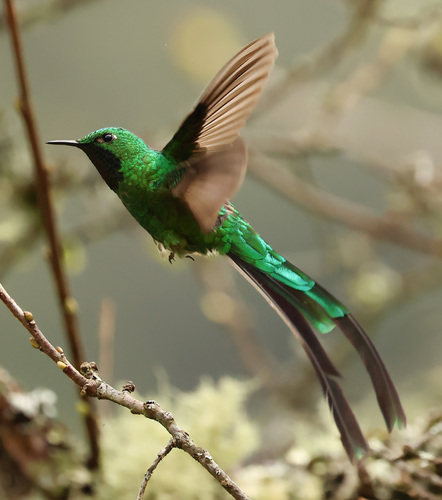
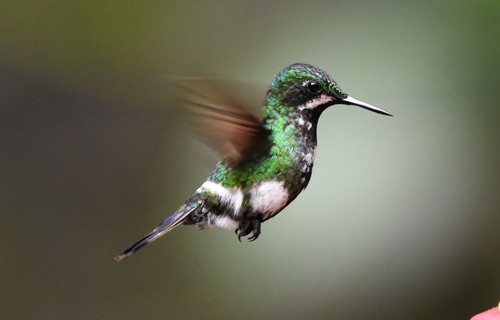
Male Discosura conversii, commonly called the green thorntail, measure between 9.5 and 10.2 cm (3.7 to 4.0 inches) in length, while females measure 6.6 to 7.5 cm (2.6 to 3.0 inches). Five unsexed individuals of this species have an average weight of 3.0 g (0.11 oz). Adult males have a dark green crown and a lighter, more metallic green back. Their coppery bronze rump contains bluish black patches and is crossed by a white band. Males have a deeply forked bluish black tail, with very narrow outer feathers that give the species its common name. The male's throat is bright metallic green; most of its breast and belly is darker green, with a metallic greenish blue center to the breast. Adult females share the same upperpart coloration as males, but their rump is darker. A female's tail is notched but not elongated. All tail feathers except the outermost pair are bluish black with dark green bases; the outermost tail feathers have white bases, a blue-black middle section, and white tips. Females have a broad white cheek patch on their face. Their chin is dull black with white spots, their flanks are dull green with a single white spot, and their breast and belly are dull black. Juvenile green thorntails resemble adults, but have a grayish white chin. The green thorntail is distributed on the Caribbean slope of Costa Rica, and on the Pacific slopes of Panama, Colombia, and Ecuador, extending almost to the Peruvian border. It is also thought to occur on the Caribbean side of eastern Panama. The species primarily inhabits the forest canopy, living in the upper levels of the interior and edges of humid montane forest and lowland evergreen forest. It can also be found at flowering trees in clearings. Its elevation range varies by region: it occurs mostly between 700 and 1,400 m (2,300 to 4,600 ft) in Costa Rica, 600 to 1,200 m (2,000 to 3,900 ft) in Panama, from near sea level to 1,000 m (3,300 ft) in Colombia, and 300 to 1,000 m (980 to 3,300 ft) in Ecuador.