About Discophora sondaica Boisduval, 1836
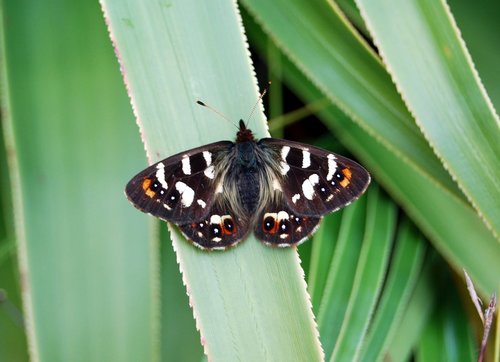
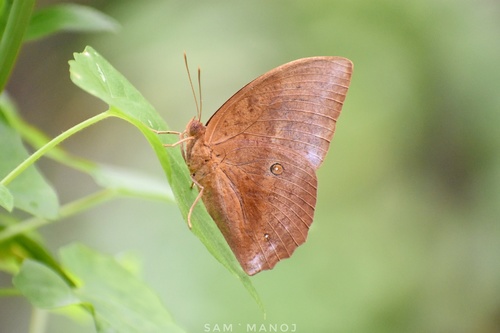
Discophora sondaica Boisduval, 1836 displays distinct sexual dimorphism in its wing coloration and patterning. For males, the upper wing surface is dark brown. The forewing bears three transverse series of bluish spots: a discal series, a postdiscal series, and a subterminal series, with the postdiscal and subterminal series placed very close together. The male hindwing is mostly uniform in color, with a prominent discal secondary sex-mark, and only faint traces of a subterminal series of pale spots. The underside of both male wings is a dull ochraceous brown, with the basal half of each wing darker than the outer half. This darker basal area is bordered outward by an even darker, obscure transverse band that ends in a diffuse, lilac-toned small patch at the tornus of the hindwing. Both the male forewing and hindwing are sparsely speckled with short, transverse brown striae, and carry a faint lilac tint. The male hindwing also has two poorly defined ocelli, matching the ocellus pattern seen in Discophora celinde. Male antennae are ochraceous, while the head, thorax, and abdomen are brown, and a paler shade of brown on the ventral side. Females have a purplish brown upper wing surface. The female forewing has three transverse series of white spots; the innermost, discal series extends to the costa via two large, elongated, obliquely positioned white spots. The female hindwing also has three transverse rows of spots, which are somewhat obscure and ochraceous in color. The underside of the female's wings matches the pattern of the male's underside, but is paler overall.