About Discoglossus sardus Tschudi, 1837
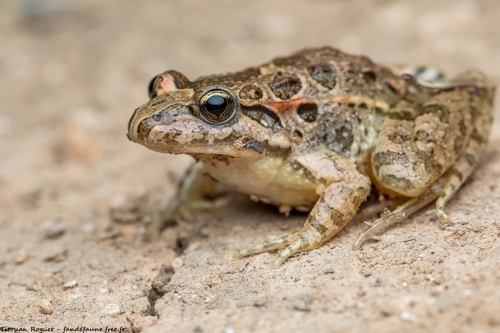
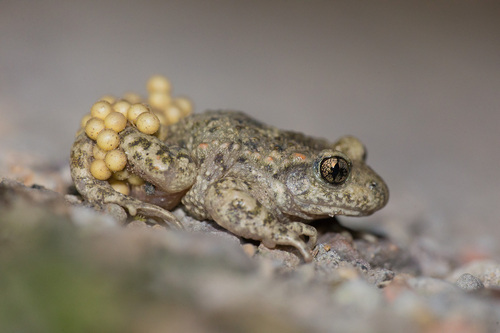
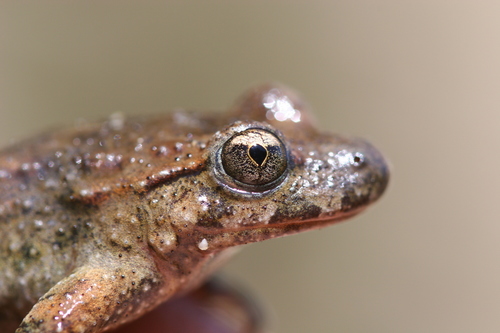
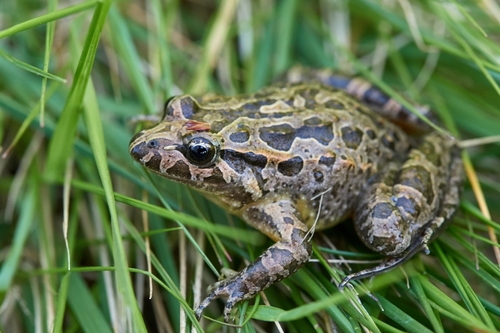
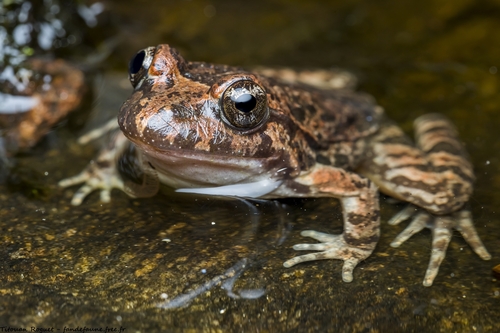
The Tyrrhenian painted frog (Discoglossus sardus Tschudi, 1837) is a short, robust amphibian, with a total length between 5 and 7.5 cm (2.0 to 3.0 in). Its base color ranges from dark brown, grey, and black to reddish brown. Light spots are very common across individuals, and unpatterned plain individuals are rare. Most individuals have a large light spot between the shoulders, and a large dark spot between the eyes that has a straight, lighter front edge. A bright crescent-shaped spot can sometimes be present on the top of the head between the snout and the midpoint of the eyes, near the shoulder girdle. The frog's belly is colored yellowish to cream white. Its pupil is shaped like a reverse droplet, and its iris is divided between a lighter golden upper half and a darker lower half, a trait characteristic of the genus Discoglossus. Like other species in this genus, the eardrum is barely visible. The skin is most often smooth, though males develop dry, rough skin during the mating season. Soft warts appear on the neck and limbs, often arranged in line patterns. The head is longer than it is wide, with a slightly pointed, narrowed snout that is noticeably more pointed than that of D. montalentii. The fourth finger on the frog's front foot is spatulated rather than tapering, and its hind legs are relatively short. This species is distributed across most of the islands of Corsica and Sardinia, though it is absent from the central highlands of these islands. It also occurs on several small islands in the Tyrrhenian Sea, including the Iles d'Hyères, Giglio, and Montecristo, as well as the Monte Argentario peninsula in Tuscany. Its natural habitats include coastal plains, forest streams, maquis shrubland, and upland coniferous forests. It breeds in slow streams and pools, and can tolerate brackish water.