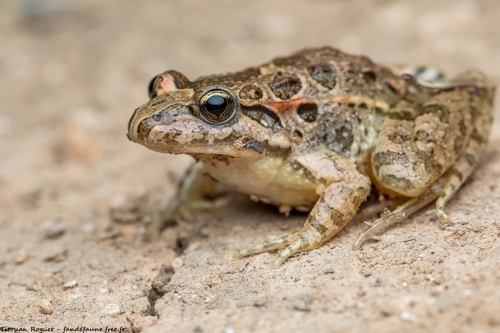
About Discoglossus pictus Otth, 1837
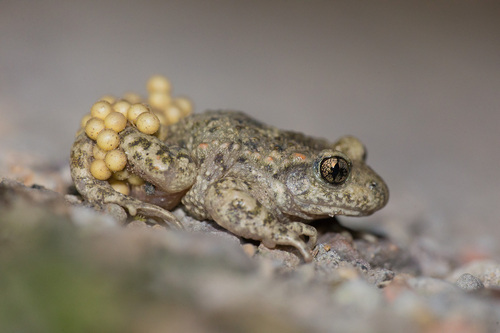
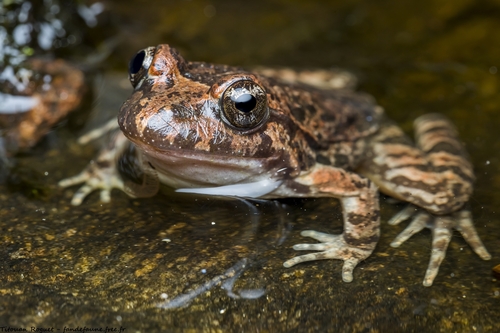
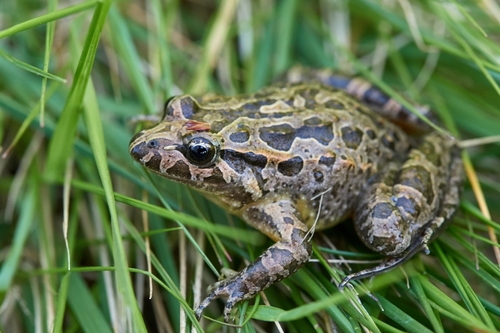
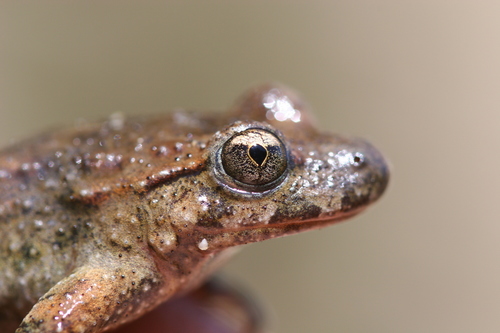
Discoglossus pictus Otth, 1837, commonly known as the painted frog, has three distinct body pattern variations matching its common name reference to colorful markings. The variations are: almost uniformly colored individuals, individuals with large dark spots that have bright edges, and individuals with two dark brown longitudinal bands, one bright band along the back, and two bright bands along the sides. This species has a whitish belly, a stout body, and a flat head that is wider than it is long. Dorsal glands on the back are either arranged in longitudinal lines or entirely absent. Its pupils have the shape of an upside-down droplet.
In North Morocco, the mating season for D. pictus runs from January to early November. During copulation, the male clasps the female in the lumbar region. Copulation typically lasts around two hours for North Moroccan individuals, while it only lasts 35 seconds to 2 minutes in Spanish specimens. Females can lay a total of 500 to 1000 eggs in a single night. Females mate with multiple males, and after each copulation, they lay a small clump containing 20 to 50 eggs. Individual ova usually measure 1.0 to 1.5 mm in diameter, and their surrounding gelatinous envelope measures 3.7 mm. Eggs do not share a common collective envelope, instead forming a loose mass that either rests on the water surface or sinks to the bottom. Eggs generally hatch after 2 to 6 days. Newly hatched tadpoles are around 3 mm long. Over 1 to 3 months, they grow to approximately 33 mm before metamorphosing into 10 mm froglets. In Sicily, many populations of D. pictus live in man-made water bodies including stone-sided cisterns, irrigation pipes, and canals in cultivated areas.
The native distribution of D. pictus covers Mediterranean North Africa, including northeast Morocco, northern Algeria, and Tunisia, as well as the Italian island of Sicily and the island of Malta. Introduced populations are located in northeastern Spain and southwestern France. Discoglossus scovazzi, a species from Morocco, was previously classified as a subspecies of D. pictus. Early research thought only D. scovazzi occurred in Morocco, but later studies confirmed D. pictus is also present in the country.
D. pictus is listed as Strictly Protected Fauna under the Bern Convention of the Council of Europe. The species is generally threatened by agricultural intensification, though populations that live along rivers, in seasonal ponds, and in swamps appear to be less endangered. Introduced populations in the northeast of the Iberian Peninsula may pose a threat to some native frog species, particularly in shared aquatic habitats. In North Africa, the species is very abundant, especially in the subhumid northern regions, and its range extends to pre-Saharan oases. Populations on Malta are reported to be threatened by falling groundwater levels. The species has been introduced multiple times to the island of Comino, but the introduced Levant water frog (Pelophylax bedriagae) in the Maltese archipelago is a direct competitor of D. pictus. More data on the ecology and biology of D. pictus is needed to support effective protection of the species. At least across part of its range, D. pictus is associated with man-made water bodies.