About Discodoris boholiensis Bergh, 1877
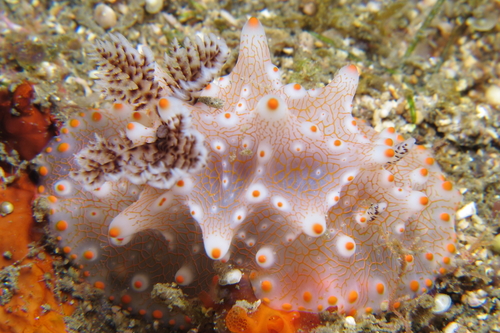
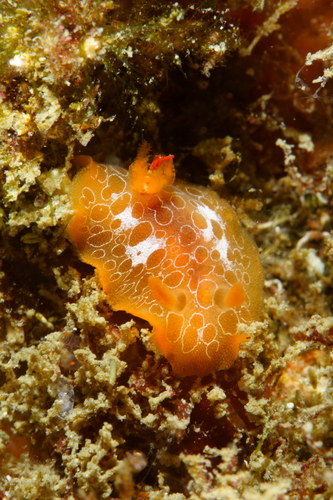
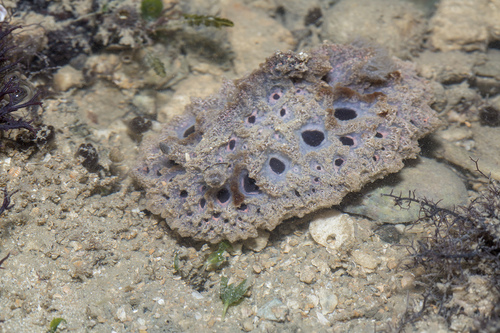
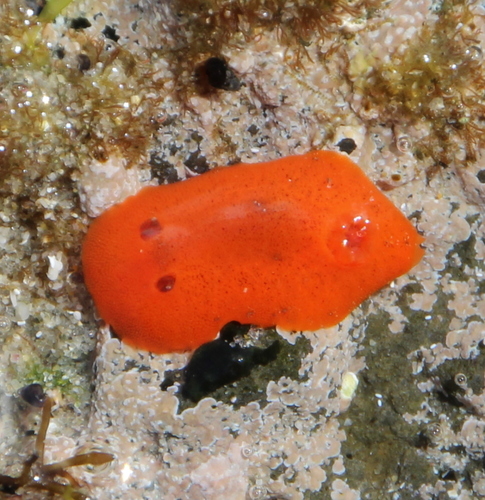
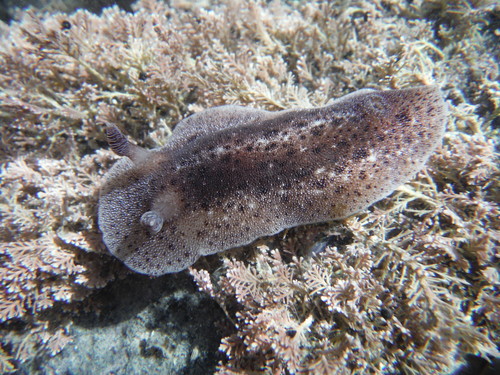
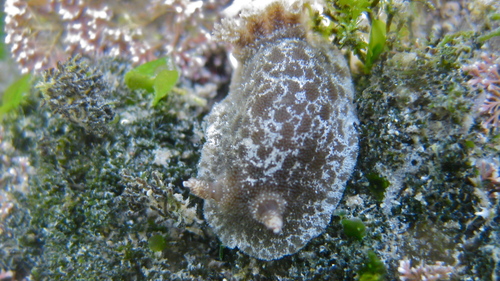
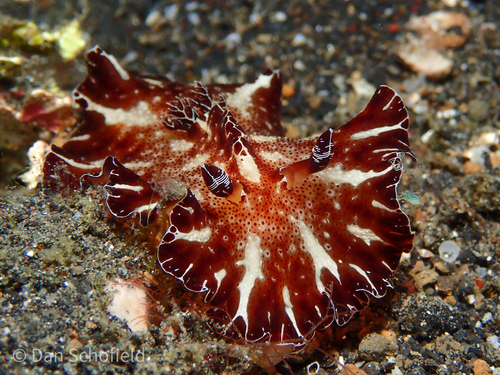
Discodoris boholiensis has a roughly oval, broad, rather flattened body with a wavy margin, reaching up to 12 cm (5 in) long and 8 cm (3 in) wide. Its head is not clearly separated from the rest of the body. The dark brown rhinophores bear a vertical white line on their anterior surfaces, and can retract into dark brown sheaths that also have wavy margins. A thicker longitudinal ridge called the visceral hump runs down the center of the sea slug's dorsal surface; this structure is translucent and whitish, marked with irregular brown patches and spots. It has six retractable external gills, with the rearmost two divided into two branches; the gills are brown with a distinct pattern of white lines. The mantle edge is undulating, leathery and semi-rigid, streaked with dark brown and creamy-white, beige or yellowish tones, and dotted with dark brown and white speckles. On the underside of the animal, the long oval foot is much narrower than the mantle, and has a dark brown edge. This species is widespread across tropical waters of the Indo-Pacific region, ranging from the eastern coasts of Africa and Madagascar to Japan, Papua New Guinea, New Caledonia and Australia. It inhabits reefs on both hard and soft substrates, among corals and under overhangs, at depths down to approximately 15 m (50 ft). Discodoris boholiensis is nocturnal, and spends the daytime hiding in crevices or other concealed locations, often folding or twisting its mantle into unusual shapes to fit into the space. If it is caught out in the open during daylight, it will crawl quickly across sand, but it moves much more slowly when active at night; this behaviour is called photokinesis. When attacked or disturbed, it readily autotomises, losing parts of its mantle and later regenerating the lost tissues. It feeds mainly on sponges. Like other dorid nudibranchs, Discodoris boholiensis is a hermaphrodite. Its genital opening is located on the right side of the animal near the edge, and two mating individuals position themselves head-to-tail to mate. Sperm is exchanged through a channel, and fertilization is internal. Eggs are laid as an orange-brown spiral gelatinous ribbon, deposited on a horizontal or vertical surface, which swells as it absorbs water.