About Discaria toumatou Raoul
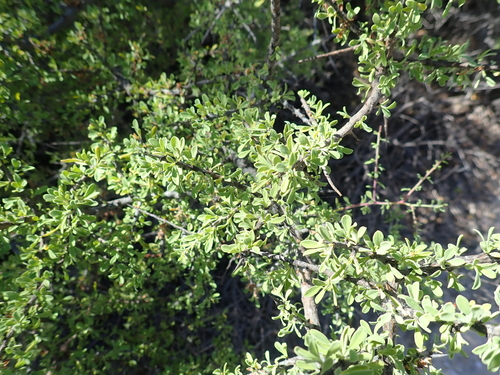
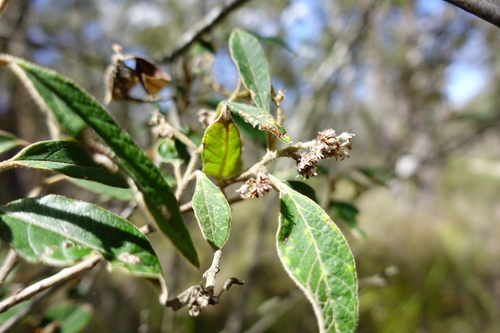
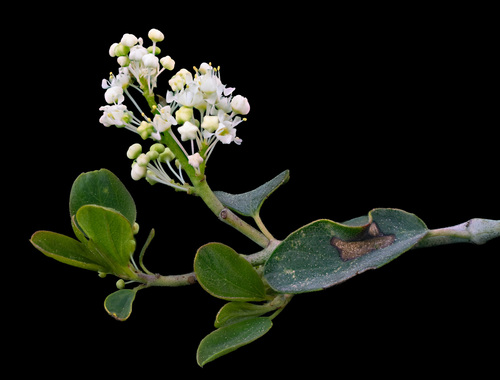
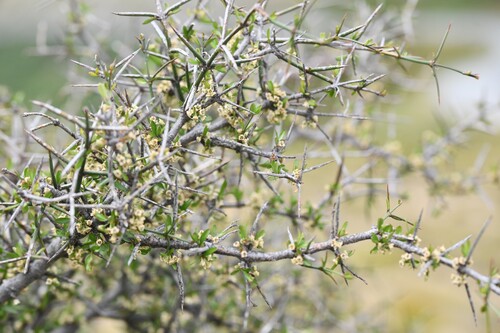
Discaria toumatou Raoul, commonly known as matagouri, is a tangle-branched, extremely spiny divaricating shrub; it occasionally grows into a small tree reaching up to five metres tall, with rough grey bark. It is deciduous, producing very small leathery leaves mostly in spring and early summer. These glossy green leaves grow at the base of its spines, which may be several centimetres long. Young spines are green, and they turn grey as they mature. Matagouri is the only native New Zealand plant that produces this type of spine. Its tiny, scented white flowers have no petals, and only 4–5 triangular petal-like sepals. Flowers appear between October and December, and are followed by small three-lobed green to brown fruits from January to March. Matagouri is common in the eastern South Island and Chatham Island, and occurs in a small number of coastal localities in the North Island south of the Waikato River mouth. It frequently forms thickets in lowland to montane tussock grassland, stony areas, sand dunes, and river beds, and grows occasionally in subalpine scrubland. Like other species in the genus Discaria, matagouri fixes atmospheric nitrogen with assistance from symbiotic bacteria of the genus Frankia in its roots, allowing it to grow in nutrient-poor habitats. It often grows in association with mingimingi (Coprosma propinqua), porcupine shrub (Melicytus alpinus, an alpine mahoe), native brooms (Carmichaelia species), and the introduced weed sweet briar (Rosa rubiginosa). Matagouri grows slowly, and undisturbed plants can live over 100 years. Māori used matagouri spines for tattooing when no better tool was available. In 1997, matagouri was planted alongside other Wellington coastal species on traffic islands along Petone Esplanade in Lower Hutt.