About Disa ferruginea Sw.
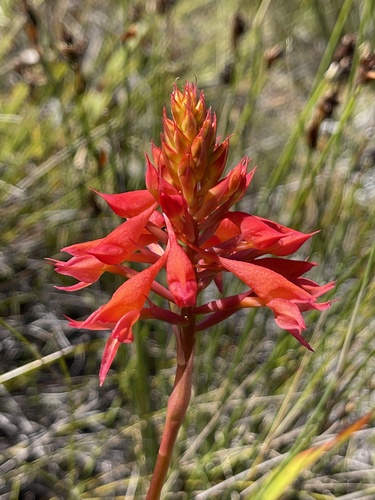
Disa ferruginea Sw. is a sturdy, reed-like terrestrial orchid that typically reaches 200 to 450 mm in height. It produces linear radical leaves that develop after flowering, while its dry cauline leaves form sheaths around the stem. It bears a dense inflorescence holding 1 to 40 flowers, which are bright red to orange, often with yellow elements. The median sepal has an apiculate tip, and forms a hood-like galea 8 to 10 mm deep. The slender flower spur tapers into the galea and measures 7 to 20 mm long. Lateral sepals project outwards, and are elliptic to narrowly elliptic, with apiculi up to 4 mm long. The petals are spear-shaped, 5 to 7 mm long, while the lip is narrowly ovate to spear-shaped and 10 to 12 mm long. This species is endemic to the South-Western Cape of South Africa, where it grows in fynbos vegetation. It occurs occasionally or commonly in dry to slightly damp areas, usually in the zone affected by southeaster clouds, at elevations ranging from 400 to 1,500 m. It blooms between February and March, and fire acts as a stimulus to trigger its flowering. It hybridizes very rarely with Disa graminifolia. Disa ferruginea is exclusively pollinated by the mountain pride butterfly, Aeropetes tulbaghia. The species does not produce nectar for visiting butterflies, instead it lures pollinators through deceptive mimicry of nectar-producing flower species. In the south-western Cape, a red-flowered form of Disa ferruginea mimics the red reedpipe, Tritoniopsis triticea, while an orange-flowered form in the Langeberg Mountains mimics the red hot poker, Kniphofia uvaria. Disa ferruginea is most closely related to either Disa porrecta or Disa gladioliflora; both of these related species also use deceptive mimicry to attract pollinators. Disa porrecta is another red-flowered, butterfly-pollinated species, while Disa gladioliflora is pink-flowered and pollinated by flies and Amegilla bees.