About Disa bracteata Sw.
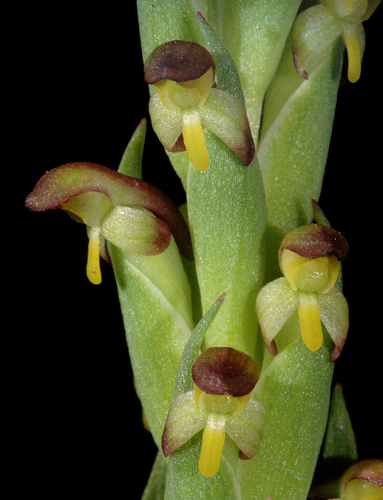
Disa bracteata Sw. is a tuberous geophyte that typically grows up to 30 cm (12 in) tall, though taller specimens have been recorded. Its leaves are linear-lanceolate, 4–12 cm (1.6–4.7 in) long, with rounded bases and sharply pointed tips. Flowering occurs between September and November. Flowers are arranged in a many-flowered cylindrical inflorescence that is 2–12 cm (0.79–4.72 in) long. The bracts are slightly longer than the flowers themselves. The flowers are bi-coloured, with greenish-yellow lower sections and helmet-shaped maroon upper sections. Its helmet-shaped sepals measure 2.5–4.5 mm (0.098–0.177 in) long, while the shallowly triangular spur is 3–4.5 mm (0.12–0.18 in) long. The pendent lip has an oblong to oblanceolate shape. The anther is also pendent, and the rostellum has a large notch. This species is endemic to South Africa, where it occurs in the Western Cape and Eastern Cape. It grows from sea level up to 2,000 m (6,600 ft) altitude, in Fynbos, Renosterveld, and Albany Thicket habitats. It thrives particularly well in disturbed habitats such as roadsides, where it is more common and grows at higher densities than in undisturbed sites. Disa bracteata is invasive and naturalized in Australia, one of the few orchid species to become naturalized there. It was first recorded in Western Australia in 1944, South Australia in 1988, and Victoria in 1994; there is also a single recorded population in Tasmania. At invaded Australian sites, up to 80 individuals can be found per square metre. Similar environmental conditions between Australia and South Africa have allowed D. bracteata and many other South African native species to become naturalized across parts of Australia. This species is known to be capable of self-pollination.