About Dirinaria frostii (Tuck.) Hale & W.L.Culb.
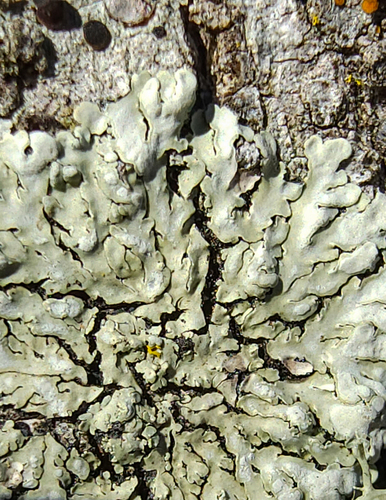
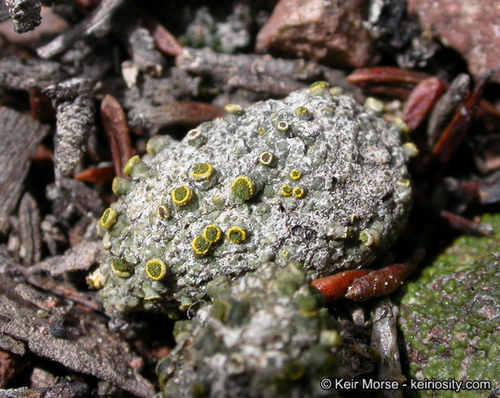
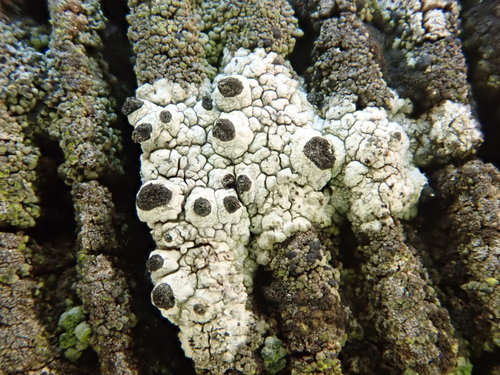
Dirinaria frostii has a foliose thallus that grows tightly appressed to agglutinated, with a diameter ranging from 1 to 3 cm. Its lobes are dichotomously pinnately or subpinnately lobate, radiating, and often confluent. The upper surface may be gray, bluish gray, or yellowish gray, and sometimes features patchy white pruinosity. Soredia start out growing along the margins, and later spread to the lamina, while pseudocyphellae are mainly found on the margins. The medulla is most often white, and occasionally has orange spots at the tips of the lobes. The lower surface is black at the center, and fades to a paler color towards the lobe tips. Apothecia are rarely produced; when present, they bear brown, 1-septate ascospores. Chemical spot tests show the upper cortex reacts K+ yellow, C−, KC−, P+ yellow, while the medulla reacts K−, C−, KC−, P−. Secondary metabolites produced by the species include atranorin in the upper cortex, divaricatic acid in the medulla, and small amounts of a few terpenes. For habitat and distribution, Dirinaria frostii grows primarily on rocks, and is occasionally found growing on bark. It favors shaded locations, such as those within thorn forests and deciduous forests. Its range covers the northern and southeastern United States, extending from the upper Great Lakes region and southern New England south to the southern Atlantic and Gulf coastal states. In Mexico, it is especially abundant in Baja California Sur, Chihuahua, and Sonora.