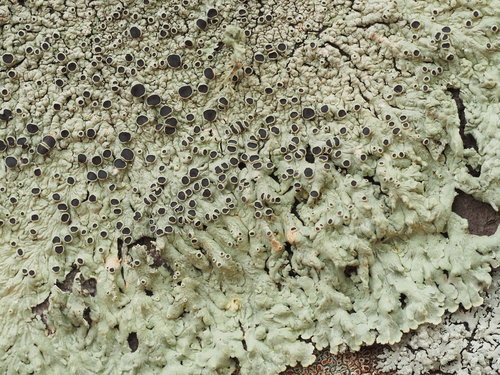
About Dirinaria confusa D.D.Awasthi
Dirinaria confusa D.D.Awasthi has a foliose thallus that is mostly appressed, with lobe tips that are loosely appressed. The thallus can reach a maximum diameter of up to 8 cm. Its lobes are pinnately or subpinnately lobed, spreading and often merging with each other. They are usually flat or convex, and occasionally concave towards their tips, with a width ranging from 0.2 to 3 mm. The lobe tips have a characteristic distinct fan-like shape. The upper surface of the thallus ranges in color from gray, bluish gray, and off-white to straw-colored. It may be slightly powdery or lack a powdery coating entirely. No soralia, isidia, or polysidiangia are visible on the thallus, but distinct pseudocyphellae are present, mainly on the surface and lobe edges, and these pseudocyphellae sometimes form interconnected patterns. The medulla is either fully white, or has a faint orange tint at its base. The lower surface of the thallus is dark at the center, and lightens gradually towards the lobe tips, and it does not produce any rhizines. This species is commonly found growing on bark and wood, particularly near coastal areas. It is distributed across tropical and subtropical regions of North America, Central America, and South America, with well-documented populations in Texas.

