About Dipteryx alata Vogel
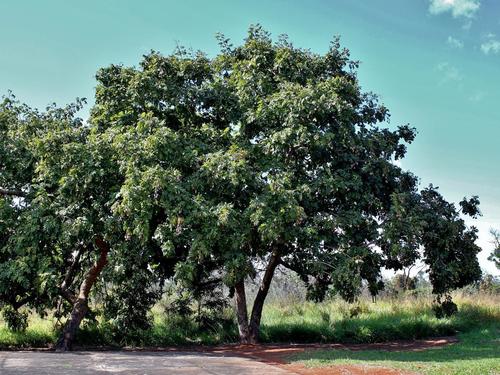
Dipteryx alata Vogel is a tree that can reach up to 25 metres (82 ft) in height and 0.7 m (2+1⁄2 ft) in diameter. It bears compound leaves with between 6 and 14 leaflets. Its greenish-white flowers measure 6 to 15 millimetres (1⁄4 to 5⁄8 in) in diameter. Its fruit is an ovoid bean pod that contains juicy flesh inside. The fruit has an average weight of 25 g, with an average length of 52.40 ± 4.48 mm and an average width of 38.31 ± 4.05 mm. By composition, 42% of the fruit is pulp, 53% is ligneous endocarp, and 5% is seed. This species is native to Bolivia, Brazil, Paraguay and Peru. In Bolivia, it has been recorded in northwestern Bolivia in Abel Iturralde Province (northern La Paz Department) and Madre de Dios Province (Pando Department), and in southeastern Bolivia in Andrés Ibáñez, Chiquitos, Germán Busch, Ichilo, Ñuflo de Chávez, Sara and José Miguel de Velasco provinces, all within Santa Cruz Department. It grows in the tropical savannah of the Chiquitania region, occurs within Noel Kempff Mercado National Park, and is thought to grow in Madidi National Park. In Brazil, it can be found in suitable habitat across central and western Brazil. It occurs in the north in the states of Pará and Tocantins, in the west in Acre, Amazonas and Rondônia, in the northeast in Bahia, Maranhão, and Piauí, and possibly in Ceará, in the central-west in Distrito Federal, Goiás, Mato Grosso and Mato Grosso do Sul, and in the southeast in Minas Gerais, Paraná, and along the Atlantic coast of São Paulo. According to Siqueira et al. (1992), the species is almost extinct in the wild in Paraná and São Paulo, where it is found almost exclusively planted outside of its native range. In Paraguay, it has been recorded in central eastern Paraguay in the departments of Amambay and Concepción. In Peru, it has been recorded in the departments of Huánuco (Pachitea Province), Loreto (Maynas and Ucayali provinces) and Madre de Dios (Tambopata Province). Among all species in the genus Dipteryx, this species has the most southerly distribution, and is the only one that grows in regions with distinct marked seasons. It is found in the Amazon, Caatinga, and Cerrado (central Brazilian savannah) phytogeographical regions. It grows mostly in Cerrado vegetative associations, but also occurs in tropical riverine and/or gallery forests, seasonally semi-deciduous tropical forests, and Amazonian savannahs. It grows in low-fertility soil in northern Bolivia, but in Goiás it is typical of Cerrado areas with higher soil fertility, where it occurs uniformly. It can reliably be used as an indicator species for these conditions, as recorded by Macedo (1992), and does not grow in areas of naturally very low soil fertility. Indigenous peoples across the species' native range use it for lumber, charcoal production, and as shade in pastures. The fruits are often used as cattle feed, and the seeds are a nutritious part of the diet of local communities. According to Alexiades, some Ese Ejja people who have recently begun using the hallucinogenic drug ayahuasca experience visions of concrete houses while under the drug's influence; a source interviewed by Alexiades states that these visions represent this tree species. Alexiades theorizes that this tree is considered a "teacher plant" in the new form of ayahuasca shamanism adopted by the Ese Ejja, and that this tree specifically, and trees in general, represent the "future". The tree has a useful lifespan of 60 years. While it grows wild, there have been recent attempts at large-scale cultivation. In the cerrado, the fruit matures shortly before the rainy season, which occurs between June and October depending on latitude. Ripe brown fruits are either collected from the ground or picked from the tree when they are almost ripe. Extracting baru fruit is a profitable alternative to deforestation, and several cerrado communities rely on revenue from selling baru fruits and seeds. The fruit's pulp is sweet and nutritious. It can be eaten fresh, and is also used to make jams, jellies, and liquors. Baru seeds are high in fat, proteins, dietary fibers, magnesium, iron and zinc.