About Dipsosaurus dorsalis (Baird & Girard, 1852)
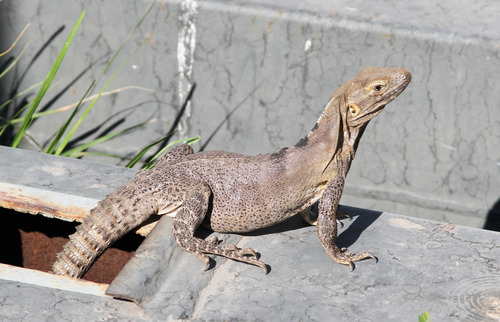
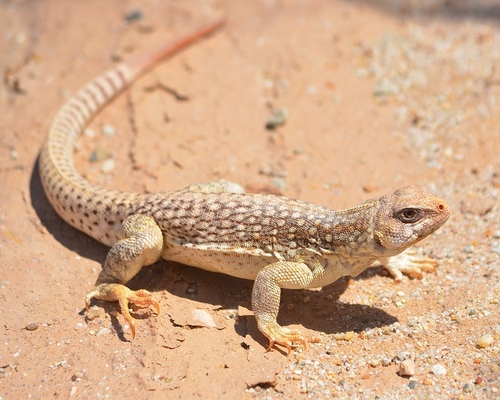
The desert iguana, Dipsosaurus dorsalis, is a medium-sized lizard. Its average total length is 41 cm (16 in), and it can reach a maximum total length of 61 cm (24 in) when including the tail. Its base color ranges from pale gray-tan to cream, with a light brown reticulated pattern across its back and sides. A row of slightly enlarged, keeled dorsal scales runs down the center of the back, growing slightly larger toward the lower back. Near the back legs, the reticulated pattern transitions to brown spots, which become stripes along the tail. The tail is typically around one and a half times longer than the body measured from snout to vent. The belly is pale, and during the breeding season, both sexes develop pinkish coloring on their sides. This lizard's preferred habitat falls largely within the range of the creosote bush, mostly in dry, sandy desert scrubland below 1,000 m (3,300 ft). It has a substantial population in the Sonoran and Mojave deserts, and can also be found in rocky streambeds up to 1,000 m. In the southern part of its range, it lives in arid subtropical scrub and tropical deciduous forest. Desert iguanas tolerate high temperatures, and remain active after other lizards have retreated to their burrows. They seek shade when their body temperature reaches the low forties Celsius, and retreat to the protection of a burrow when their body temperature hits the mid forties Celsius. They burrow extensively, and if threatened will scamper into a shrub and quickly enter a burrow. Their burrows are usually dug in sand under bushes such as creosote, and they also often reuse burrows dug by kit foxes and desert tortoises. Reproduction influences their habitat selection: it is thought that high-temperature environments support more successful egg hatching, and eggs typically hatch when environmental temperatures range between 28 and 38 degrees Celsius. Mating occurs around May to June. Desert iguanas produce only one clutch of eggs per year, with each clutch holding 3 to 8 eggs. Hatchlings emerge around September. They are primarily herbivorous, feeding on the buds, flowers, fruits, and leaves of many annual and perennial plants. They are especially attracted to the flowers and leaves of the creosote bush and alfalfa. They also eat insects, particularly ants, crickets, and mealworms, as well as the feces of other herbivores. Predators of adult desert iguanas and their eggs include birds of prey, foxes, rats, long-tailed weasels, and snakes.