About Dipsacus laciniatus L.
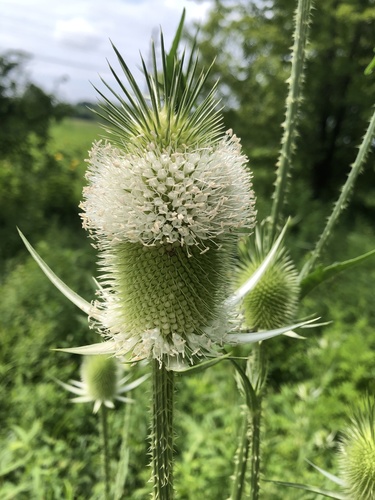
Dipsacus laciniatus, commonly called cutleaf teasel, is a flowering plant species in the honeysuckle family. It is native to Europe and Asia, and is an introduced, invasive weed in North America. This perennial herb can reach a height of two to three meters. Its erect branching stem is hollow and prickly. Its leaves grow in opposite arrangements, with each pair of leaves joining around and clasping the stem. The bases of the leaves form a cup that often collects water. This species is monocarpic: it lives for multiple years, but only flowers once before dying. Its inflorescence is an egg-shaped head, with long bracts growing below the head. A single head may contain up to 1500 flowers. Each individual flower lives just one day. Blooming starts in the middle of the head, then spreads to the upper and lower parts. The fruit is an achene that is just under one centimeter long. This plant reproduces only by seed. Cutleaf teasel can be distinguished from its close relative common teasel (Dipsacus fullonum) by flower color and leaf shape: cutleaf teasel has white flowers and deeply cut leaves, while common teasel has purple flowers and leaves with toothed or wavy edges. Cutleaf teasel is a weed in the United States, where it is most widespread across the Midwest and northeastern states. It has been recorded in New York and Michigan since before 1900, and is now a dominant species in some areas, including an Illinois tallgrass prairie. It grows in a wide range of habitat types, and grows best on high-quality soil; plants growing on fertile soil develop into large, robust individuals. In non-native regions like the U.S. Midwest, there are no natural biological control agents for the species, so it can form large dense monocultures that displace native plant species. It is also able to tolerate saline soils. After identifying and considering seven insect species associated with the plant, two moth species were tested for use as biological control agents in Slovakia between 2003 and 2004. One of these tested moths is the monophagous Endothenia gentianaeana. Endothenia gentianaeana could be reared in large numbers, and was found on nearly 100% of the teasel plants surveyed in Slovakia. The second tested moth, Cochylis roseana, caused a high level of damage to cutleaf teasel, and unlike Endothenia gentianaeana, it was not frequently targeted by local parasitic wasps. As of February 2018, the United States Department of Agriculture (USDA) has not approved the introduction of either moth species for cutleaf teasel control. Instead, the USDA continues to recommend the use of herbicidal chemicals. In 2007, research suggested that the mite Leipothrix dipsacivagus could be another candidate biological control agent.