About Dipsacus fullonum L.
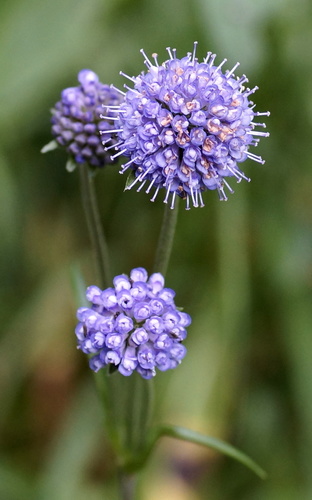
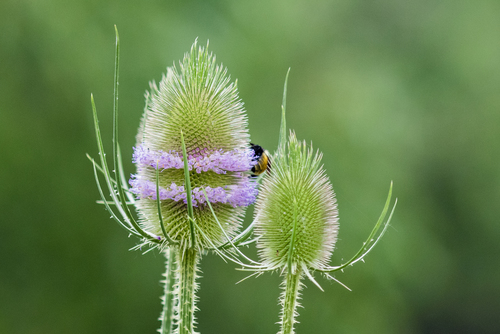
Dipsacus fullonum L., commonly known as common teasel, gets its genus name from the word for thirst. This name refers to the cup-shaped structure formed where sessile leaves join the stem, which can hold collected rainwater. It has been proposed that this water-filled receptacle works to block sap-sucking insects like aphids from climbing the plant's stem. Its leaves are lanceolate in shape, measuring 20–40 centimetres long and 3–6 centimetres wide, with a row of small spines along the underside of the leaf midrib. Teasels are easily recognized by their prickly stems and leaves, and by their inflorescence: clusters of purple, dark pink, or lavender flowers that form a dense head at the end of stems. The flower head is ovoid, measuring 4–10 centimetres long and 3–5 centimetres wide, with a basal whorl of spiny bracts. Flowering begins in a belt around the middle of the spherical or oval flower head, then opens sequentially toward the top and bottom of the head, forming two narrow flowering belts as it progresses. After flowering finishes, the dried flower head remains on the plant, and small 4–6 millimetre seeds mature in mid-autumn. Francis Darwin, son of Charles Darwin, discussed potential carnivory in teasels in a paper held by the Royal Society. Modern repeated attempts to replicate Francis Darwin's experiments on common teasel have kept debate active over whether Dipsacus is truly carnivorous. A 2011 study found that increased seed production (but not increased plant height) depended on both the amount and type of added animal material, while 2019 experiments suggested the increased seed production was a response to poor soil conditions rather than evidence of proto-carnivory. In terms of ecology, teasel seeds are an important winter food source for some bird species, most notably the European goldfinch. Teasels are often grown in gardens and promoted on some nature reserves specifically to attract these birds. The Sativus Group cultivar of Dipsacus fullonum, called fuller's teasel and also synonymized as D. sativus, was historically widely used in textile processing. It acted as a natural comb to clean, align, and raise the nap on fabrics, especially wool, a process called fulling. Fuller's teasel differs from wild Dipsacus fullonum in having stouter, slightly recurved spines on its seed heads. Dried flower heads were attached to spindles, wheels, or cylinders (sometimes called teasel frames) to tease fibers and raise nap on fabric. By the 20th century, teasels were largely replaced by metal cards, which could be produced uniformly and did not need constant replacement as teasel heads wore down. Even so, some wool weavers still prefer to use teasels for raising nap, claiming the result is better; specifically, if a teasel encounters strong resistance in the fabric, it will break, while a metal tool would rip the cloth. Teasels are also occasionally grown as ornamental plants, and their dried heads are used in floristry.