About Diprion similis (Hartig, 1834)
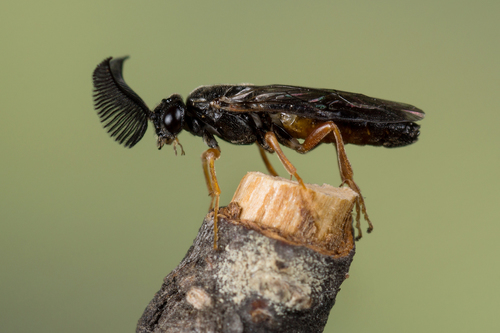
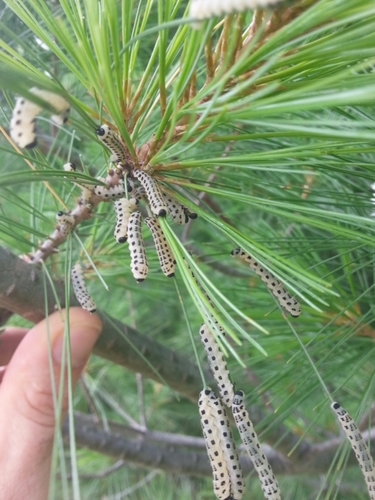
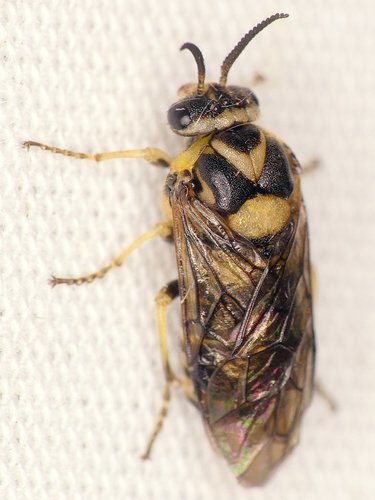
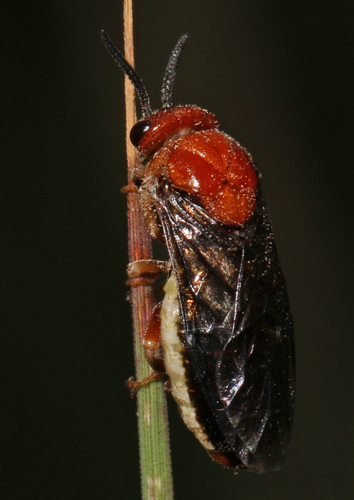
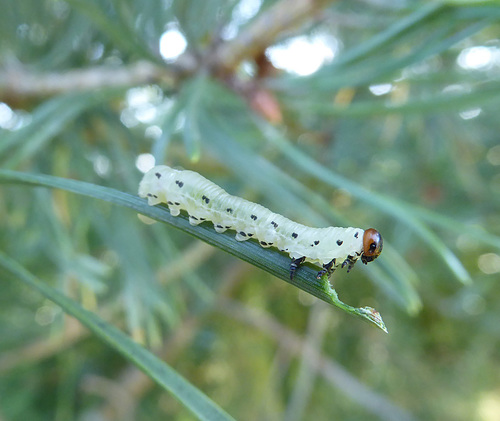
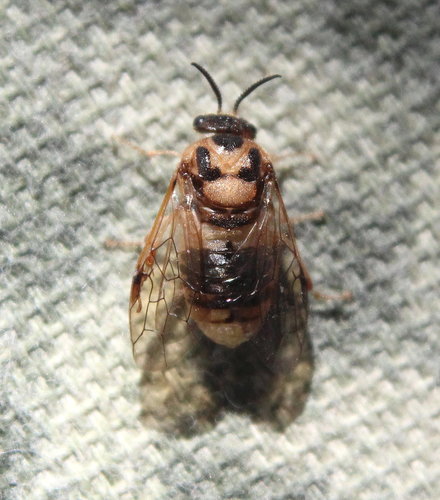
This species has the scientific name Diprion similis (Hartig, 1834). Adult males measure 7 to 9 mm (0.28 to 0.35 in) in length. They are mostly black, except that the underside of the abdomen is sometimes reddish-brown. Their antennae are black and bipectinate, or feather-like, and their legs are yellow, with brownish-black coloration on the trochanters and the base of the femora. Adult females are between 7.5 and 10 mm (0.3 to 0.4 in) long. They have a black head and thorax, and their abdomen is usually yellow and black, though some females are fully dark. Female antennae are black and serrate, or saw-like, and their legs are yellow with dusky bases. Larvae have black heads and resemble lepidopteran caterpillars. Females go through six instars, while males go through five. The first three instars are yellowish-green. Later instars have black longitudinal stripes, plus yellow and white patches, on a bluish and black background. D. similis is native to central and northern Europe, including Fennoscandia, Russian Siberia as far east as the Lake Baikal region, and China. It was first detected in North America in 1914 in Connecticut, and has since spread to most of eastern United States and eastern Canada, occurring wherever Pinus strobus grows. It feeds on other pine species, but prefers P. strobus when it is available. Diprion similis is arrhenotokous, meaning it uses a form of parthenogenesis where unfertilized eggs develop into male offspring. Fertilized eggs develop normally into both male and female offspring. Haploid males have n = 14 chromosomes, while diploid females have 2n = 28 chromosomes. Adults emerge in spring or later in the year, and remain active through most of the summer. Females cut a slit into a pine needle with their ovipositor and lay around ten eggs. Unmated females can lay viable eggs that all develop into male offspring. Newly hatched larvae stay together in groups, but later larval stages live independently. They feed on pine needles until they are ready to pupate. The first generation spins cocoons in July and emerges as adults in August. The second generation typically drops to the ground, spends the winter in a cocoon as a prepupa, and pupates the following spring. Some individuals can remain in the prepupal state for up to three years. As an introduced species in North America, this sawfly faces little competition from native sawfly species and has become an invasive pest. It has few predators or parasites in the New World, and its ability to reproduce via parthenogenesis has allowed it to thrive. Sawflies use pheromones to attract members of the opposite sex for breeding. The main pheromone component emitted by D. similis is the (2S,3R,7R)-propionate isomer of 3,7-dimethylpentadecan-2-yl. Neodiprion pinetum, another sawfly that also feeds on white pines, uses the (2S,3S,7S)-acetate isomer as its main pheromone component instead.