About Diprion pini (Linnaeus, 1758)
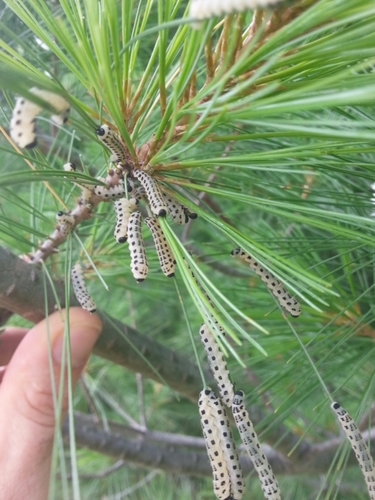
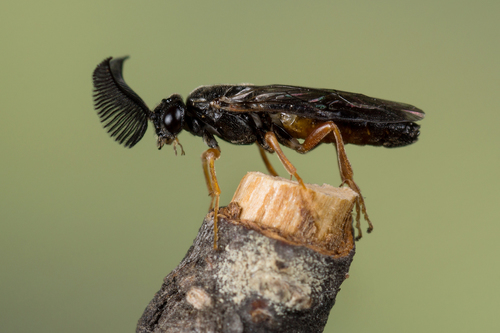
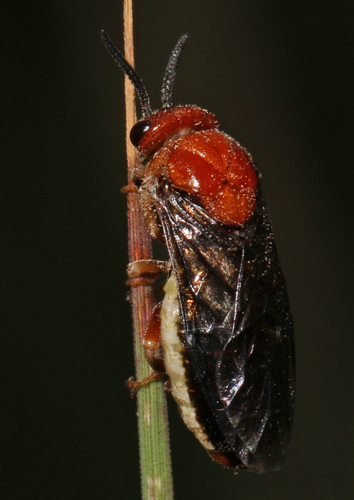
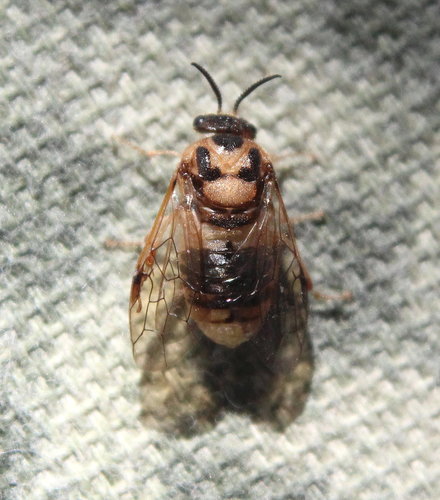
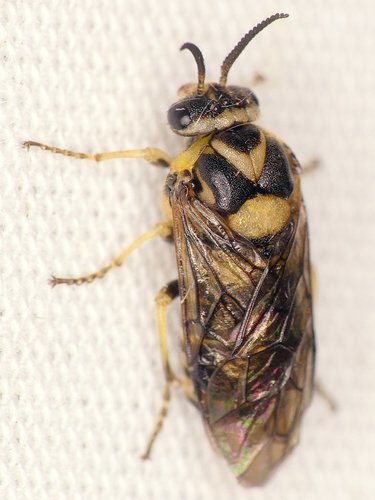
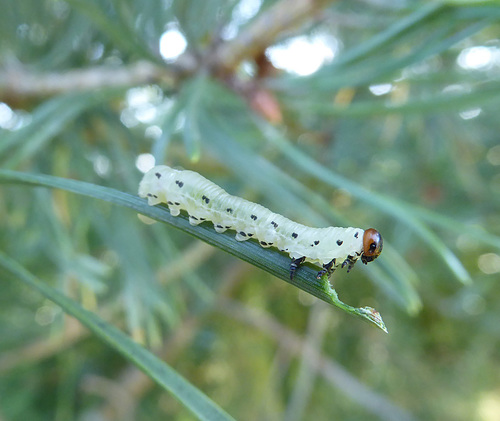
This species has the scientific name Diprion pini (Linnaeus, 1758). Adult individuals (imagos) measure 7–10 millimetres (0.28–0.39 in) in length. Their bodies are arched, and they bear 26-segment antennae. Diprion pini is sexually dimorphic: males are slightly smaller than females and differ in coloration. Males are black-brown or solid black, with pectinate (comb-like) antennae. Females are pale yellow with dark markings, have a heavier build, and possess saw-shaped antennae along with a saw-shaped ovipositor, the organ used for laying eggs. Adults do not feed and only live for a few days. Males of this species are haploid, while females are diploid with 2N=28 chromosomes. Eggs are approximately 1.4 millimetres (0.055 in) long, elongated, and kidney-shaped. Caterpillar larvae are pale yellow or yellow-green with a brown head. A line runs along the 7 pairs of abdominal prolegs, and the true legs are dark. Last-stage larvae can reach up to 25 millimetres (0.98 in) in length; these mature larvae have brown heads and light green bodies marked with black spots. Pupae broadly resemble adult Diprion pini in shape. Each pupa develops inside a yellow-brown cocoon that is 8–12 millimetres (0.31–0.47 in) long. Diprion pini is widely distributed across Europe and Russia, and is also found in Algeria, Siberia, and Turkey. Climate conditions and the presence of suitable pine species including Scots pine make most of the United States a viable area for this pest, so it is considered a potential threat there. Around 84% of this species' genetic variation occurs within populations, but upland populations show some degree of reproductive isolation, indicating reduced gene flow between different altitudes. The host plants of this pine sawfly are pine species, including Pinus banksiana (jack pine), P. cembra (arolla pine), P. contorta (lodgepole pine), P. mugo (mountain pine), P. nigra (black pine), P. pinaster (maritime pine), P. radiata (radiata pine), P. strobus (eastern white pine), P. sylvestris (Scots pine), P. uncinata (mountain pine), and P. wallichiana (blue pine). Feeding experiments testing ten of these pine species found large variations in food suitability that strongly impact larval growth and mortality; Scots pine is the most suitable food source, while maritime pine is the least suitable. This species does not act as a vector for plant pathogens, but damage from sawfly feeding weakens pine trees, leaving them more vulnerable to secondary attacks such as infestation by the pine shoot beetle Tomicus piniperda.