About Dipogon lignosus (L.) Verdc.
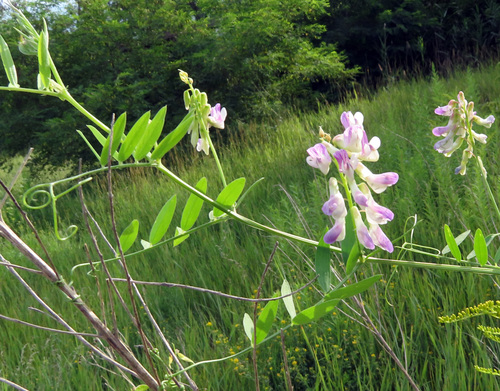
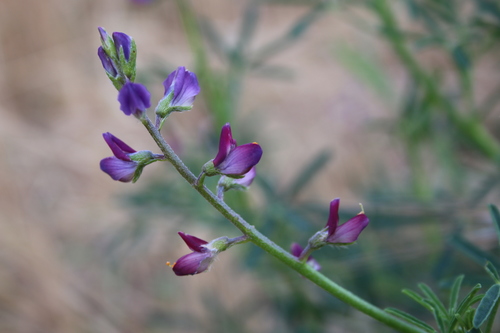
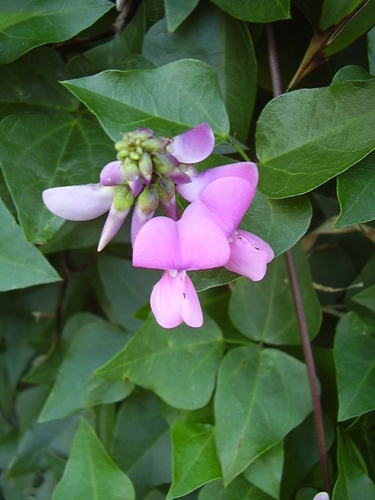
Dipogon lignosus (L.) Verdc. is a climbing, herbaceous woody perennial that becomes woody towards its base. Its soft green stems climb over nearby structures, shrubs, or trees, growing up to 2 metres tall, and can extend a long distance horizontally when possible. Its leaves are dark to medium green on the upper surface, and paler on the lower surface. Each leaf is made of three diamond-shaped leaflets that have a wide base before tapering to a fine point, and each leaflet has its own stalk. The flowers of this species are typical of the pea family, and come in shades of pink, mauve, magenta, and purple. They grow at the tips of new growth stems, arranged in short, dense racemes with long peduncles. Flowering occurs throughout spring and summer, which corresponds to August to January in its native South Africa. Soon after flowering, it produces flat, sickle-shaped pods, each containing four to six seeds. In warmer climates, Dipogon lignosus is an evergreen, but it may become deciduous in areas that experience frosts. The native range of Dipogon lignosus covers the Western Cape and Eastern Cape of South Africa, where it prefers mild areas that are not subject to frost. It is an invasive weed in Australia and New Zealand, and control of this species is mandated in some regions of these countries. In its native South Africa, the natural habitat of Dipogon lignosus is forest margins and stream banks, where it climbs over other shrubs and trees. In Australia, it retains the same general habitat preference, but is usually found close to human habitation. It prefers to grow in moderately shady sites, where dense vegetation can provide support for its twining stems. When its pods ripen, seeds are explosively ejected, landing some distance from the parent plant. Seeds can remain dormant in soil for several years when conditions are not favourable for germination. Germination is stimulated by disturbance such as fire, rain, or seasonal changes. As a legume, Dipogon lignosus hosts symbiotic nitrogen-fixing bacteria that grow in nodules on its roots. These bacteria improve soil fertility: the plant provides the bacteria with nutrients and shelter, while the bacteria supply the plant with usable nitrogen collected from soil minerals. This species is also tolerant of salt-laden winds.