About Dipodomys ordii Woodhouse, 1853
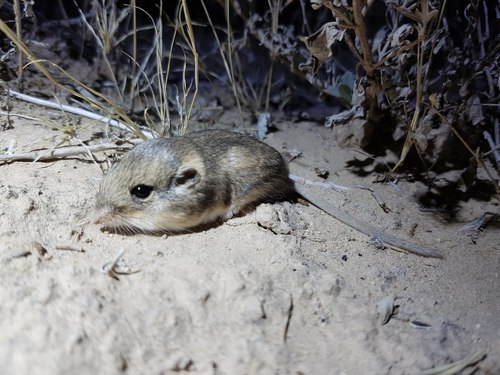
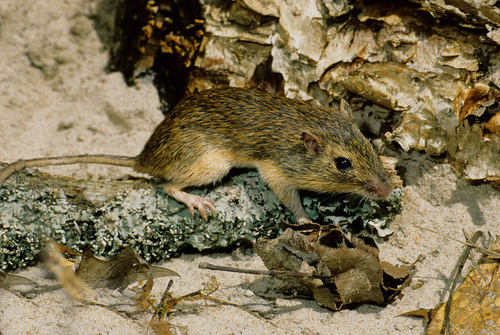
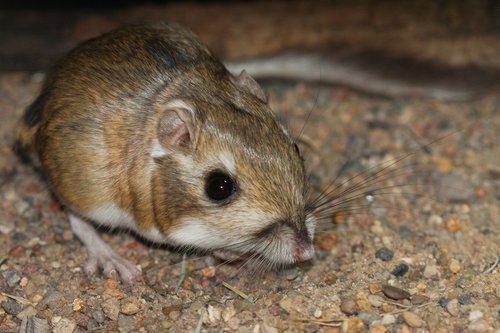
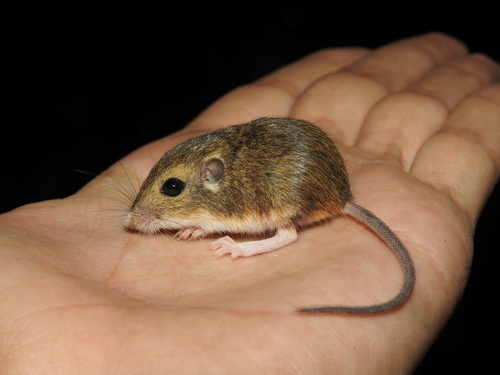
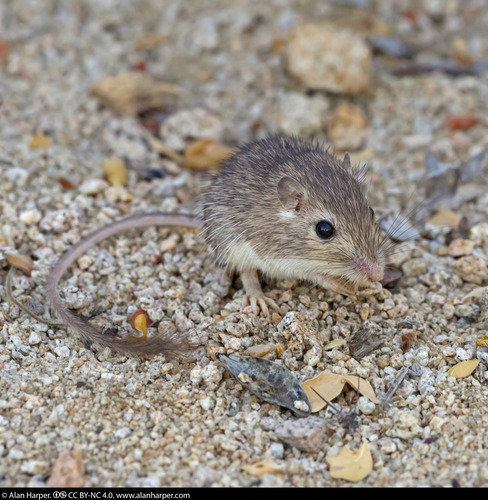
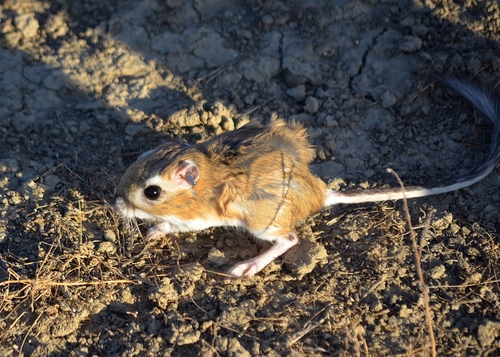
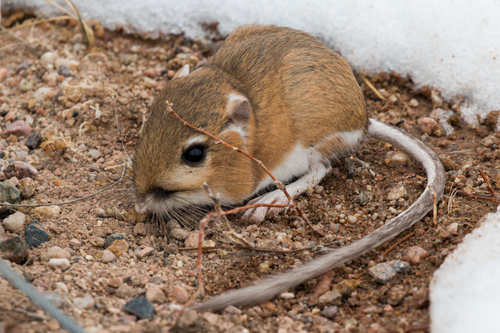
Ord's kangaroo rat (Dipodomys ordii) is a species of kangaroo rat native to western North America. Its native range covers the Great Plains and the Great Basin, extending from extreme southern Canada to central Mexico. This species has a fifth toe on its hind feet, a trait that distinguishes it from Dipodomys elator. It is bicolored, with gold-brown hair along its dorsal side and a white underbelly. It has a long tail with a bushy tip; the tail is dark on both its dorsal and ventral sides, with a white lateral stripe running along it. Its hind feet are modified for jumping, measure over 35 mm in length, and the species' total body length exceeds 240 mm. Its tail is typically less than 160 mm long, another feature that distinguishes it from D. elator, which has a tail longer than 160 mm. While Ord's kangaroo rat is a common species throughout the United States, the Canadian population of the species is classified as endangered. The full range of Ord's kangaroo rat extends from southern Alberta and southern Saskatchewan in Canada south to southern Hidalgo, Mexico, and from central Oregon and eastern California in the west east to central Kansas and Oklahoma. Ord's kangaroo rats mostly inhabit semiarid, open habitats. In Nevada, they have been trapped in desert scrub with gravelly soil, flat pebble desert, and washes. In Utah, they favor open shrublands and grasslands growing on sandy soils. In the big sagebrush/crested wheatgrass (Agropyron cristatum) range of southeastern Idaho, most Ord's kangaroo rat captures occurred on disturbed sites or areas with sparse vegetation cover: sites dominated by Russian thistle (Salsola kali), cheatgrass (Bromus tectorum), and green rabbitbrush (Chrysothamnus viscidiflorus) had the most captures, followed by disturbed areas seeded to crested wheatgrass, then undisturbed big sagebrush. In western South Dakota, the species is associated with black-tailed prairie dog (Cynomys ludovicianus) towns. In Wyoming, Ord's kangaroo rats are abundant in sand dune communities where vegetation grows taller than 25 cm (10 inches) and bare ground makes up more than 40% of the area. In Colorado, the species was captured primarily in open areas with firm soil. Ord's kangaroo rats need firm or lightly compacted soil to build their burrows; highly compacted soils are too hard for them to dig. In areas of desert pavement or tough clay soils in the Trans-Pecos region of Texas, the species is restricted to pockets of windblown sand and alluvial soils along arroyos. Among Dipodomys species, Ord's kangaroo rats experience strong intraspecific competition and little interspecific competition. In New Mexico, where Ord's kangaroo rats live in sympatry with Merriam's kangaroo rats (D. merriamii), Ord's kangaroo rats were mostly captured in grassy microhabitats, while Merriam's kangaroo rats were captured more often in areas around creosotebush. When herbicide defoliation of shrubs (done to improve rangeland) reduced the live canopy cover of creosotebush, it led to an increase in bush muhly (Muhlenbergia porteri). After this treatment, Ord's kangaroo rats replaced Merriam's kangaroo rats as the dominant rodent species. This shift is thought to be caused by the change in habitat structure to open grass. Removal experiments designed to establish single-species populations of kangaroo rats were unsuccessful, because many kangaroo rats are transient and quickly occupy any vacated habitats. Only one adult Ord's kangaroo rat occupies a given burrow system, except for a brief period during breeding activity. Little territorial behavior occurs above ground, except near burrow entrances, which are defended. In New Mexico, the annual home ranges of Ord's kangaroo rats in mesquite habitat averaged 1.36 hectares (3.35 acres). In Nevada sagebrush/grassland, Ord's kangaroo rat home ranges were estimated at 0.62 hectares (1.53 acres) via the circular method and 0.43 hectares (1.06 acres) via the principal component method. Home range movements increase through spring, and again in late fall and early winter. No significant difference was found between the home ranges of male and female Ord's kangaroo rats; however, female home ranges decrease in size during reproductive periods. Recapture data from Ord's kangaroo rats in Arizona shows that the species does not travel far from its home range; most individuals were recaptured within 50 m (165 ft) of their original capture site. Data on lifetime individual movements shows that most individuals were recaptured within 100 m (330 feet) of their original capture site. In the sagebrush habitat of the Great Basin, Ord's kangaroo rats reach an average density of 113 rats per 10 ha. In intermountain salt-desert shrublands, average population density is 28 individuals per 10 ha in shadscale communities and 135 individuals per 10 ha in black greasewood (Sarcobatus vermiculatus) communities. Ord's kangaroo rats are primarily granivorous and herbivorous. They eat a wide variety of foods, but most commonly consume the seeds of grasses and forbs, along with green vegetation and dry vegetation. They occasionally eat animal material, mostly arthropods. In Colorado, seeds made up 74% of the species' diet, forbs 13%, grasses and sedges 5%, arthropods 4%, and fungi and mosses 2%. In the big sagebrush/crested wheatgrass range of southeastern Idaho, Ord's kangaroo rats consumed foods in the following order of proportion: pollen, arthropods, Asteraceae plant parts, and crested wheatgrass seeds. A study of Ord's kangaroo rat foods in Texas found that the primary foods consumed included seeds of sand paspalum (Paspalum stramineum), honey mesquite, sand bluestem (Andropogon gerardi var. paucipilus), common ragweed (Ambrosia artemisiifolia), and rose-ring gaillardia (Gaillardia pulchella). In Texas, seeds of creosotebush, gramas (Bouteloua spp.) and dropseeds (Sporobolus spp.) make up the major portion of the species' diet. Seeds of mesquite, Russian-thistle, sunflowers (Helianthus spp.), and sandbur (Cenchrus spp.) are also major dietary items. Harvested seeds are carried in cheek pouches back to burrows, where they are either consumed or cached. Ord's kangaroo rats also cache seeds in scattered shallow holes; this caching activity sometimes leads to seedling emergence. The rats can easily retrieve seeds buried at this shallow depth. A single Ord's kangaroo rat may create tens to hundreds of caches, each holding tens to hundreds of seeds. Kangaroo rats are physiologically adapted to live in arid environments. They obtain most of their required water from seeds and succulent plants. They will drink free water when it is available, but do not appear to require it to survive.