About Dipodomys heermanni LeConte, 1853
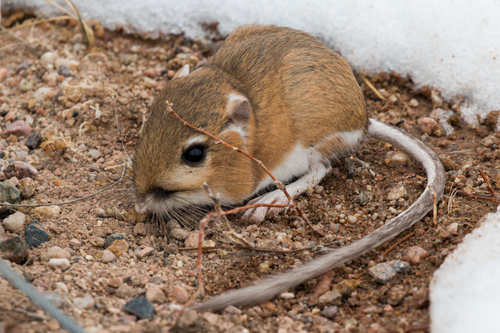
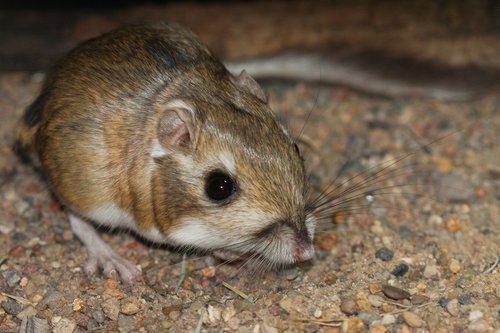
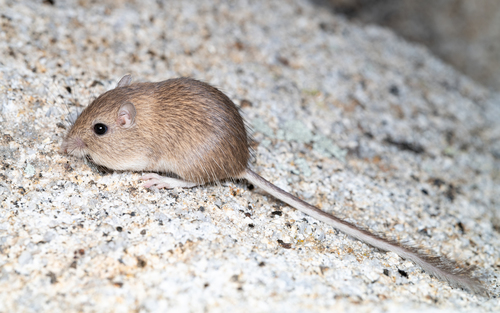
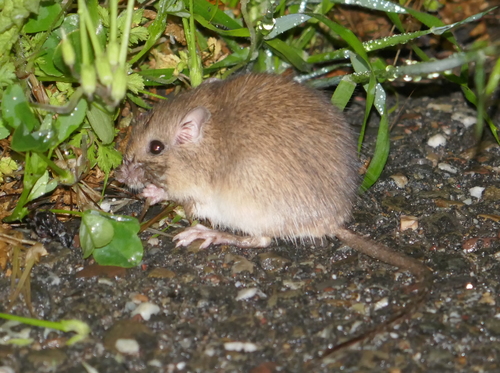
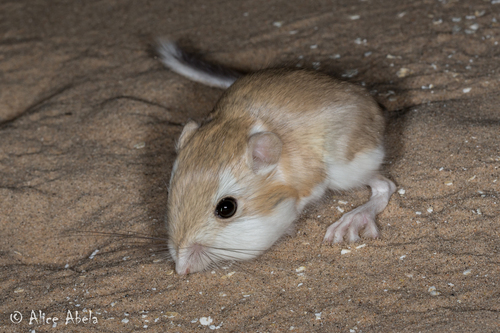
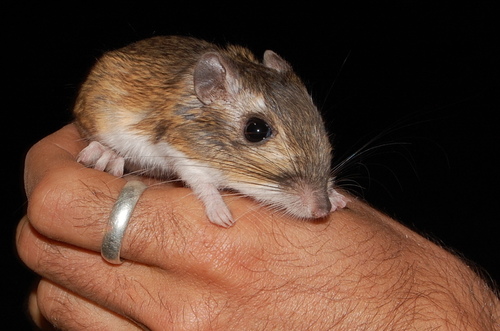
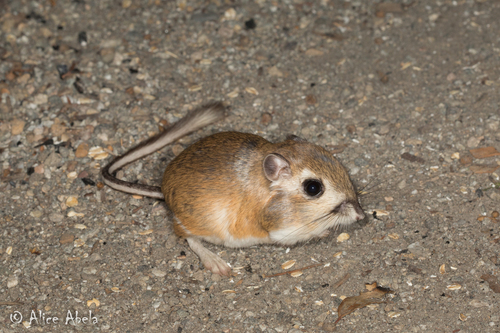
Heermann's kangaroo rat (Dipodomys heermanni) is a species of kangaroo rat, a rodent in the family Heteromyidae. Its long, smooth fur matches the typical appearance of other kangaroo rats, with a dorsal coat that mixes olive, black, and orange tones. Nine distinct subspecies of Dipodomys heermanni have been proposed. This species has a dental formula of 1.0.1.3 / 1.0.1.3 × 2 = 20 total teeth. It is characterized as "broad-faced", which distinguishes it from many other kangaroo rat species that are classified as "narrow-faced". It has five toes on each hind foot, a small trait that is important for telling it apart from related species like Dipodomys californicus and Dipodomys nitratoides. It is also smaller than Dipodomys ingens, Dipodomys venustus, and Dipodomys elephantinus. On average, Heermann's kangaroo rats have a total length of 250–313 mm (9.8–12.3 in), with tails measuring 160–200 mm (6.3–7.9 in), hind feet 38–46 mm (1.5–1.8 in), and ears 10–17 mm (0.39–0.67 in). Analysis of all standard external measurements confirms the species shows significant sexual dimorphism. It is named for Adolphus Lewis Heermann, who collected the species holotype.
Dipodomys heermanni is endemic to California, United States. Its range stretches from north to south between Lake Tahoe and Point Conception in Santa Barbara County, and from east to west between the Sierra Nevada mountain range and the Pacific Ocean. It occupies a variety of habitats, but does not occur at altitudes above 910 m (3,000 ft). Despite its small overall range, the IUCN Red List classifies Heermann's kangaroo rat as a species of least concern. The subspecies D. h. morroensis is listed as endangered by the U.S. Fish and Wildlife Service.
Because Heermann's kangaroo rat communities have interconnected surface runways shared by many individuals, it is extremely challenging to identify and measure individual home ranges, leading to widely fluctuating estimated values. One study found that more than half of all recaptured individuals were found within 30.5 meters (100 ft) of their original capture location. Home ranges vary widely between individuals and can contain different levels of vegetation cover. The species is most commonly found on coastal plains or ridges with shallow soil, and its overall range lies between the Tehachapi Mountains and the Sierra Nevada. Population density fluctuates dramatically, ranging from 2 to 30 kangaroo rats per hectare (1 to 12 per acre). It is unknown whether emigration contributes to these large fluctuations in density. Typically, only larger rats participate in emigration, and females exhibit this behavior more often than males.
Heermann's kangaroo rats are burrowing animals that modify existing tunnels made by other burrowing species like ground squirrels (Spermophilus) for their own use. The size and depth of their burrows depends on soil type: in areas with fine, deep soil, tunnels average 10.7 m (35 ft) long and reach up to 51 cm (20 in) below the surface, while in shallow, rocky soils, tunnels average 3.3 m (11 ft) long and do not go deeper than 19.4 cm (7.6 in). Burrows have one to four separate escape routes in addition to the main entrance. Heermann's kangaroo rats are granivores, and seeds make up a nutritionally important part of their diet. They are also herbivorous, especially during winter and spring. In the wild, they have been documented catching nocturnal insects including moths, beetles, and grasshoppers. They use most of the plant material found near their burrows within their home ranges. They get all the water they need from seeds and dew in their plant food, and will only drink from standing water sources if they have not gotten enough water for several weeks. When dry food matter increases and humidity drops, the mean daily activity of the rats falls drastically. Their predators include rattlesnakes, gopher snakes, owls, other raptors, coyotes, foxes, weasels, skunks, and house cats, but predation does not appear to have a significant impact on overall population densities.
The main breeding season for Heermann's kangaroo rat is a wide window from February to October, with peak breeding activity in April and declining activity starting in July. Increased sexual behavior is rare in this species. Copulation is very quick, typically lasting only a few seconds. Captive individuals do not show increased sexual behavior, and females may even act aggressively toward males when their genitalia are swollen and enlarged. During labor, female Heermann's kangaroo rats help deliver their young using their front paws. After birth, females nuzzle, smell, and lick their offspring. Newborn Heermann's kangaroo rats are bright pink, wrinkled, and hairless except for colorless vibrissae; they are poikilothermic and born with their eyes closed. Hair begins developing within 22 hours of birth, and starts gaining adult pigmentation starting at the head, reaching the feet by day 7. Sex cannot be distinguished externally before day 9, as male and female external genitalia look identical. Weaning is completed around day 25, and young begin foraging independently by 4 weeks of age.