About Dipodium roseum D.L.Jones & M.A.Clem.
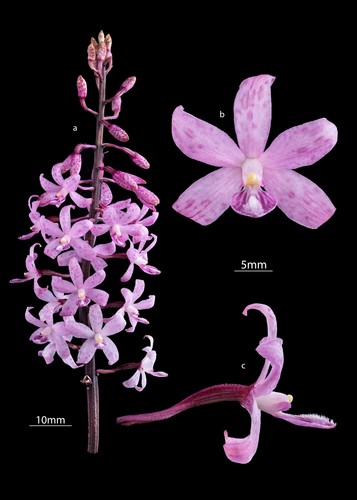
Dipodium roseum D.L.Jones & M.A.Clem. is a leafless, tuberous, perennial, mycoheterotrophic herb. Between fifteen and fifty pale pink flowers, each marked with small dark red spots and 20–30 mm (0.8–1 in) wide, grow on a green to dark reddish black flowering stem that reaches 40–100 cm (20–40 in) in height. The sepals and petals are linear to elliptic, 13–20 mm (0.5–0.8 in) long, 3–6 mm (0.1–0.2 in) wide, and are free from each other, with their tips curved backwards. The labellum is pink with dark lines, 10–15 mm (0.4–0.6 in) long, 4–6.5 mm (0.2–0.3 in) wide. It has three lobes with upturned tips; the central lobe has a broad band of pink to mauve hairs. A rare white-flowering form of this species also exists. Flowering takes place from November to February. This orchid is often confused with Dipodium punctatum. D. roseum can be distinguished by its broader band of hairs and striping on the labellum, smaller flower spots, and much more strongly recurved sepals and petals. In contrast, D. punctatum has no striping on its labellum, much more pronounced spotting on flowers, and flat or barely recurved sepals and petals. Commonly called the rosy hyacinth orchid, it grows in a range of habitats from dry woodland to wet forests. It occurs in Queensland south of Gympie, on the coast and ranges of New South Wales and the Australian Capital Territory, across most of Australia where it is the most common Dipodium species. It is also found in the south-east of South Australia, and is the only member of its genus that occurs in Tasmania. Like all species in the genus Dipodium, this species is pollinated by native bees and wasps. No leafless species of Dipodium can be maintained in cultivation, because it has not been possible to replicate the species' required association with mycorrhizal fungi in a horticultural setting.