About Diplotaxis muralis (L.) DC.
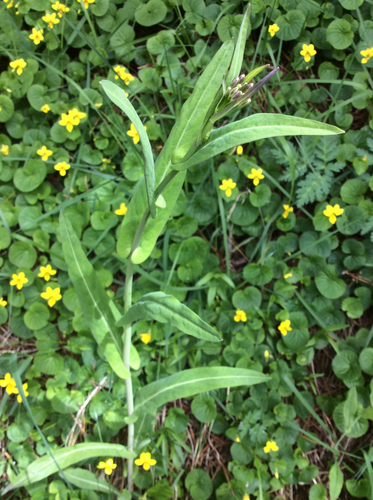
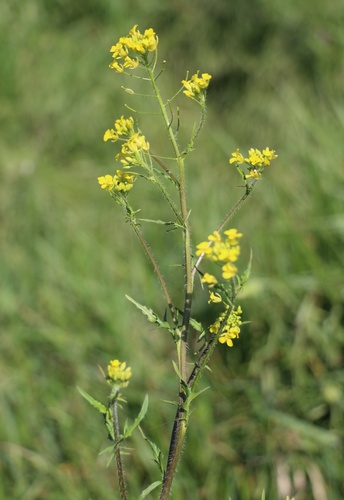
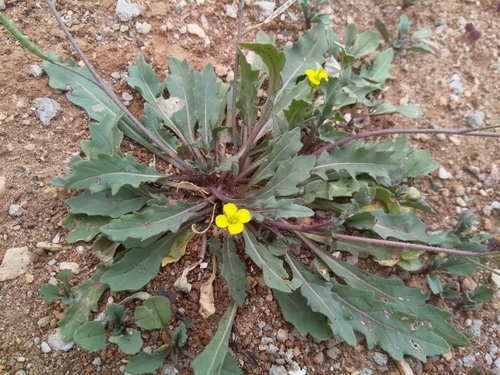
Diplotaxis muralis (L.) DC. is most often an annual plant, but can sometimes grow as a perennial. It reaches 15–60 cm (5.9–23.6 in) in height and has unbranched stems. Its lobed leaves form a rosette at the plant's base; individual leaves measure 2–9 cm (0.79–3.54 in) long and 1–3 cm (0.39–1.18 in) wide. It blooms in summer: between May and September in the UK, and between April and August in China. Its flowers are yellow, with oblong sepals and longer obovate petals. After blooming, the plant produces a long cylindrical fruit capsule with a short beak. The capsule holds two rows of yellow-brown, ovoid or ellipsoid shaped seeds. This species is native to temperate regions of North Africa, Europe, and parts of western Asia. In Africa, it occurs in Algeria, Libya, Morocco, Tunisia, and also East Africa's Ethiopia. In Asia, it can be found in the Caucasus, the country of Georgia, and Turkey. In central Europe, it is present in Austria, Belgium, Czech Republic, Germany, Hungary, the Netherlands, Poland, Slovakia, and Switzerland. In southeastern Europe, it grows in Albania, Bosnia and Herzegovina, Bulgaria, Croatia, Greece, Italy, Malta, Montenegro, North Macedonia, Romania, Serbia, Slovenia, and Ukraine. In southwestern Europe, it is found in France, Portugal, and Spain. It has been naturalized in the UK since 1778, when it was first discovered in an oat field grown from imported seeds that came from a ship wrecked on the Kent coast. It typically grows on waste and disturbed ground, including areas beside railways and roads, and on waste tips. It is pollinated by bees and other flying insects. It is occasionally cultivated and ploughed into fields to act as 'green manure'.