About Diploicia canescens (Dicks.) A.Massal.
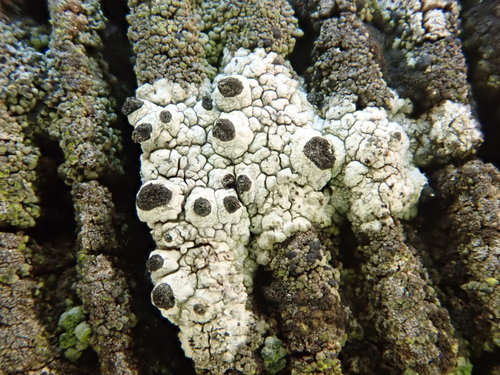
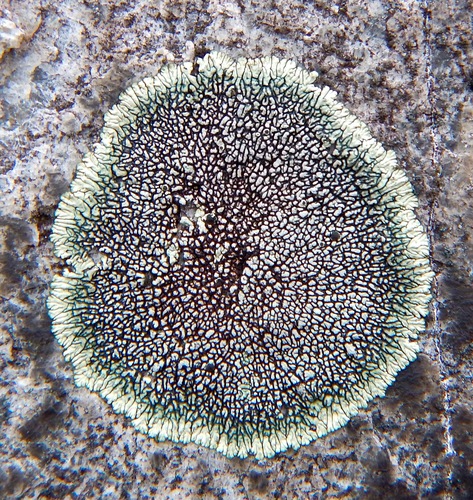
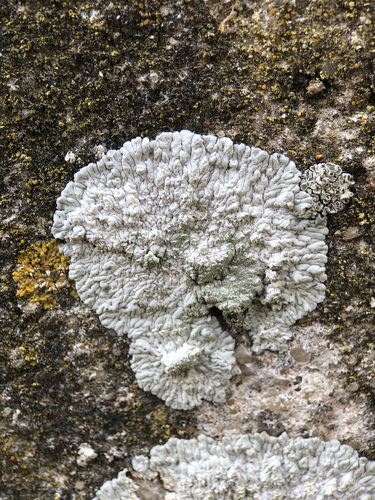
Diploicia canescens (Dicks.) A.Massal. is a placodioid crustose lichen, meaning it has a crust-like body and distinct lobed margins. It grows in rosette shapes that can reach up to 6 cm (2.4 inches) across. Its body, called a thallus, ranges in color from white to very pale gray; it is usually darker at the center, and its marginal lobes are covered in a thick, white powdery coating known as pruina. The lobes are convex, widen toward their tips, and grow up to 1 mm (0.04 inches) wide. The center of the thallus is typically covered in soralia, which are pale to slightly yellow and have a flour-like texture. The photosynthetic partner (photobiont) of D. canescens is a chlorococcoid green alga. Like many lichens, D. canescens disperses primarily through symbiotic vegetative propagules, and most thalli have extensive mats of soralia for this purpose. Sexual reproductive structures called apothecia are rare. When apothecia do form, they are black, lecideine (meaning they have no thalline margin), and measure 0.3 to 1 mm in diameter. Each ascus (spore-producing sac) contains eight spores. Each spore is brown, divided into two cells by a central septum, and measures 10–15 μm by 5–8 μm. Observations in Ireland found that apothecia only form between August and December, with spore production increasing over this period and peak spore germination occurring in October and November. Diploicia canescens has been recorded on every continent except Antarctica, though it is less common on some continents than others. It was only formally added to the list of North American lichen species in 1984; all earlier North American records of this species actually referred to a different lichen. Unlike many other lichen species, D. canescens grows abundantly on both calcareous and siliceous substrates. It most commonly grows on rocks, old walls, and tree trunks, and it favors nutrient-enriched areas such as stones where birds regularly perch. Diploicia canescens produces a range of chemical compounds. These include depsidones (diploicin, scensidin), depsides (atranorin, chloroatranorin), phthalides (buellolide, canesolide), dechlorodiploicin, and isofulgidin, plus minor or trace amounts of dechloro-O-methyldiploicin and secalonic acids A, B, and C. In in vitro studies, diploicin derivatives have been shown to be active against the bacterial species Mycobacterium smegmatis, Corynebacterium diphtheriae (mitis), and Mycobacterium tuberculosis. The global conservation status of D. canescens has not been evaluated by the International Union for Conservation of Nature. It is negatively affected by sulfur dioxide pollution, and it is slow to recolonize areas after sulfur dioxide levels decline. It is host to several lichenicolous (lichen-eating) fungi, including Arthonia diploiciae. Because it often grows in nutrient-enriched areas, it is sometimes overgrown by free-living green algae that are not part of the lichen's own structure.