About Diplodus vulgaris (Geoffroy Saint-Hilaire, 1817)
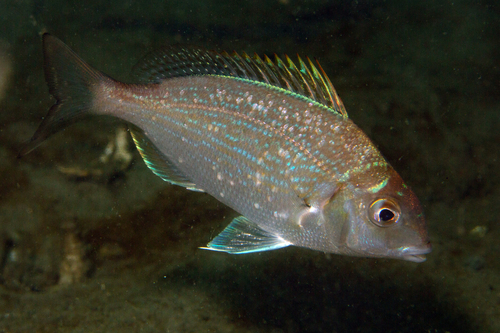
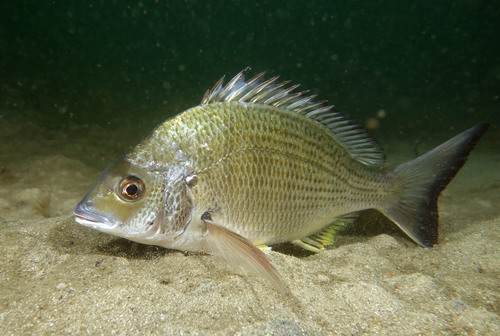
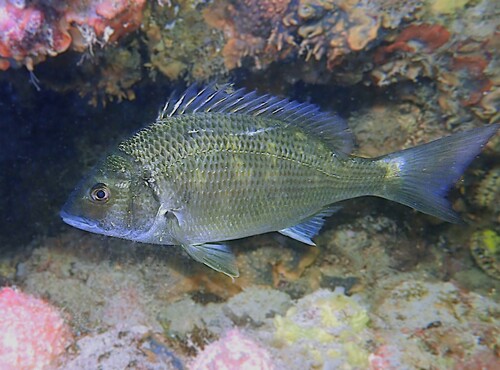
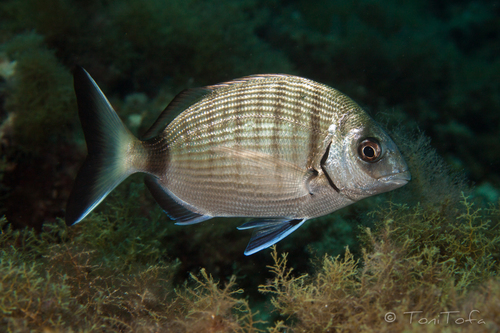
Diplodus vulgaris, commonly known as the common two-banded seabream, has an oval, deep, compressed body, with a moderately fleshy-lipped, slightly protrusible mouth. Each jaw has 8 slender brown incisor-like teeth at the front. Behind these incisor teeth, 3 to 5 rows of molar-like teeth run along the sides of the upper jaw, while the lower jaw holds 2 to 4 rows of similar molar-like teeth that also extend along the jaw sides. Its dorsal fin is supported by 11 or 12 spines and 13 to 16 soft rays, and its anal fin is supported by 3 spines and 12 to 15 soft rays. The overall body colour is grey, greenish, or brownish, and it is paler on the lower body. A dark band runs across the nape, extending to the base of the pectoral fins and the rear edge of the gill cover. A second dark band forms a ring around the caudal peduncle, located immediately behind the rearmost soft rays of the dorsal and anal fins; this band may be less extensive in young individuals. There is a black spot at the base of the pectoral fin. The forked caudal fin is dark, and darkens closer to its rear margin. All other fins are greyish, and also darken towards their margins. The maximum published total length for this species is 45 cm (18 in), though a length of 22 cm (8.7 in) is more typical. The maximum published weight is 1.3 kg (2.9 lb). Diplodus vulgaris is distributed in the northeastern Atlantic Ocean, ranging from the Canary Islands and Madeira north to the Bay of Biscay, and lives throughout the Mediterranean and Black Sea. The species has been spreading north within the Bay of Biscay, and is now found as far north as the Channel Islands and Normandy. This is an oceanodromous, euryhaline, benthopelagic fish. It occurs at depths between 0 and 160 m (0 and 525 ft), though it is most commonly found in water less than 50 m (160 ft) deep, over rocky and sandy substrates. Young individuals are often found living among seagrass beds.