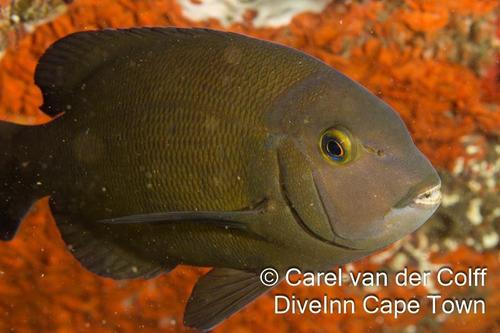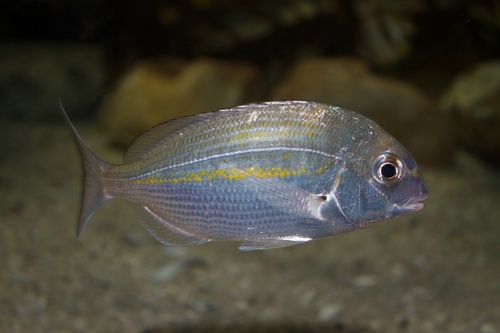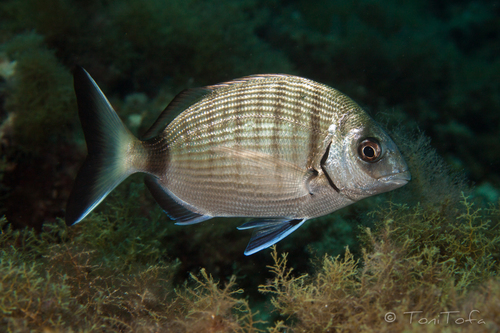
About Diplodus sargus (Linnaeus, 1758)
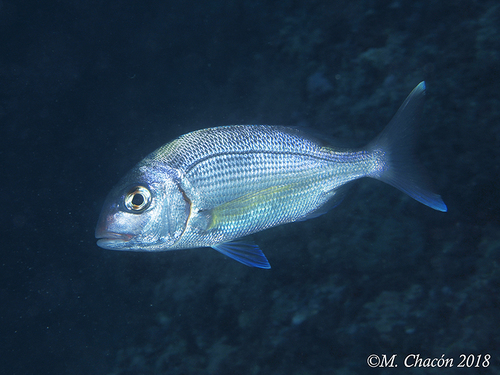
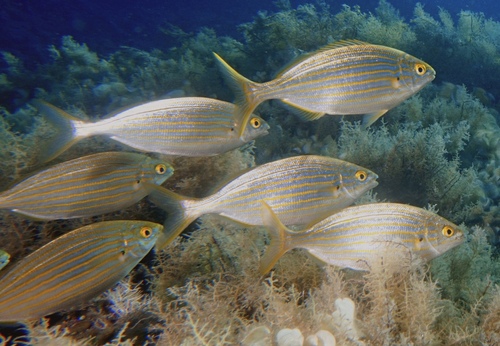
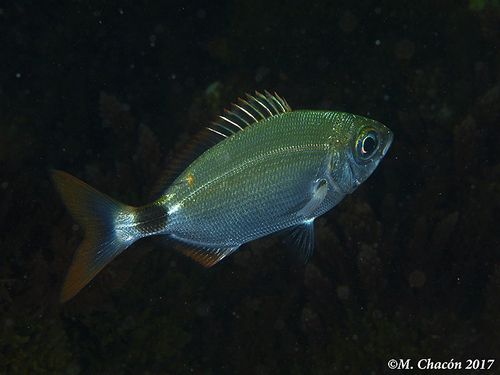
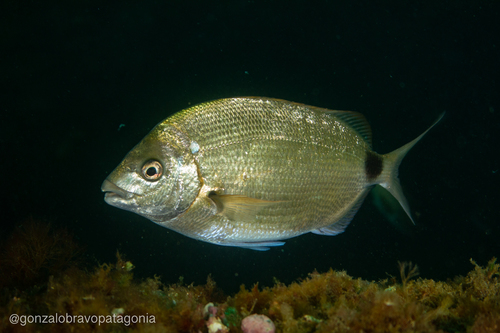
Diplodus sargus, commonly called the white seabream, has a deep, somewhat compressed body with a high, arched back. Its cheeks and gill cover are covered in scales. The mouth is located at the end of the head, with thin lips and slightly protrusible jaws. At the front of each jaw, there are 8 incisor-like teeth; the upper jaw occasionally has 10 of these teeth. Several rows of molar-like teeth sit behind these front teeth. The dorsal fin is supported by 11 or 12 spines, most often 12, and between 12 and 16 soft rays. The anal fin is supported by 3 spines and 12 to 14 soft rays, and the caudal fin is forked. The body is overall silvery-grey, with a darker colour on the front of the head. It has 9 vertical bars along the body that alternate between very dark and lighter shades, though some individuals may only have dark bars or no bars at all. A dark, saddle-shaped blotch is present on the caudal peduncle, directly behind the last soft rays of the dorsal fin. A black spot sits above the base of the pectoral fin. The dorsal and anal fins are dusky, darkening toward their outer edges, and the rear edge of the caudal fin is black. Juvenile white seabream only have 5 stripes. The maximum published total length of this species is 45 cm (18 in), with a more typical adult length of 22 cm (8.7 in). Its maximum published weight is 1.9 kg (4.2 lb). Diplodus sargus is found in the northeastern Atlantic, from southern Brittany, the Bay of Biscay, and the Atlantic coasts of Spain and Portugal into the Strait of Gibraltar, and throughout the Mediterranean and Black Sea. It is replaced by D. levantinus off the coast of Israel. Within its eastern Atlantic range, this species has been expanding its distribution northward, and has been recorded in the Channel Islands. The white seabream is a benthopelagic schooling species that inhabits coastal areas with rocky bottoms mixed with sand, at depths from 0 to 150 m (0 to 492 ft). It is most abundant in the surf zone. Young individuals live in Zostera seagrass beds, and the species uses estuaries as nursery areas.