About Diplodus puntazzo (Walbaum, 1792)
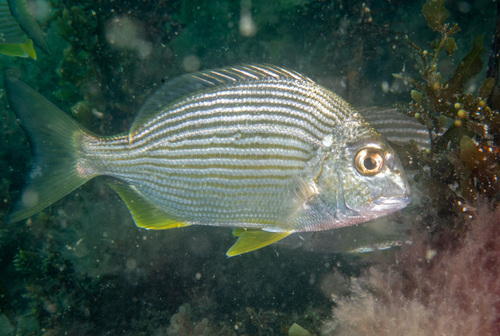
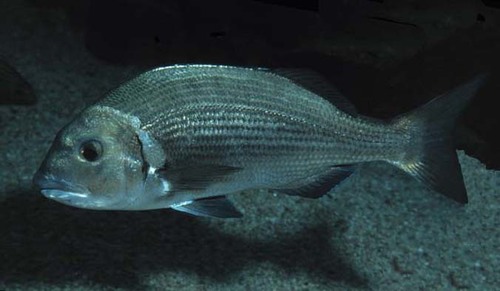
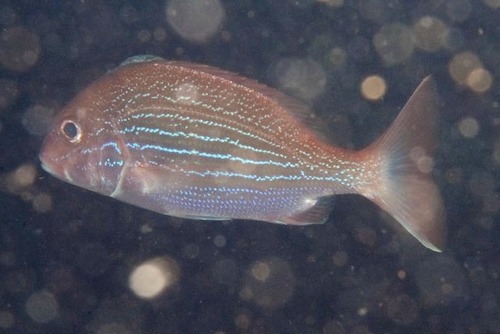
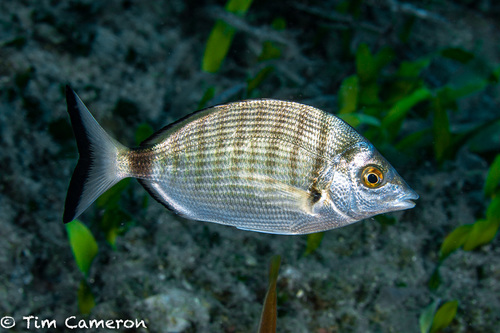
Diplodus puntazzo, commonly called the sharpsnout seabream, has an oval, compressed body with a slightly protrusible mouth and moderately fleshy lips. Both the upper and lower jaws hold 8 brown, incisor-like teeth at the front, followed by 3 or 4 rows of smaller molar-like teeth that are usually lost in adult individuals. The dorsal fin is supported by 11 spines and 12 to 15 soft rays, while the anal fin has 3 spines and 11 to 13 soft rays. The caudal fin is forked. The fish's overall body color is silvery grey, with 6 to 7 alternating dark and light vertical bars running along the upper body; these bars often fade after the fish dies. A dark bar covers most of the caudal peduncle, almost forming a complete ring, and is darkest in young fish. The outer edge of the caudal fin is black, and all other fins are greyish, darkening toward their margins. There is a distinct dark spot at the base of the pectoral fin. The maximum published total length for this species is 60 cm (24 in), though 30 cm (12 in) is a more typical size. The maximum published weight recorded for Diplodus puntazzo is 1.7 kg (3.7 lb). Diplodus puntazzo occurs in the eastern Atlantic Ocean, ranging as far north as the southern Bay of Biscay off northern Spain, where it is very uncommon, and extending south to Sierra Leone. In Macaronesia, it is only found in the Canary Islands and Cape Verde. It also lives throughout the Mediterranean and southern Black Sea. Reports of sharpsnout seabream from South Africa are confirmed to be misidentifications, and the species is increasingly recorded further north within the Bay of Biscay. The sharpsnout seabream is a benthopelagic species that inhabits marine and brackish waters. It can be found at depths down to 150 m (490 ft), but most often occurs in water less than 60 m (200 ft) deep. It lives in coastal waters over rock or sand substrates. Young individuals typically inhabit brackish water, tidal pools, and lagoons, while adults are found in the surf zone.