About Diplodus hottentotus (Smith, 1844)
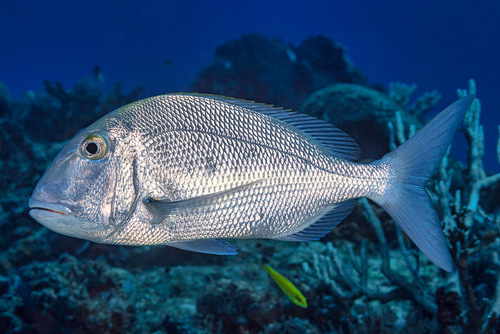
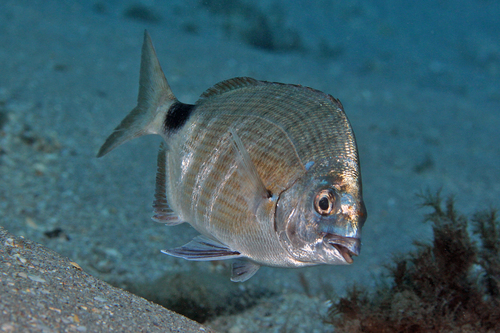
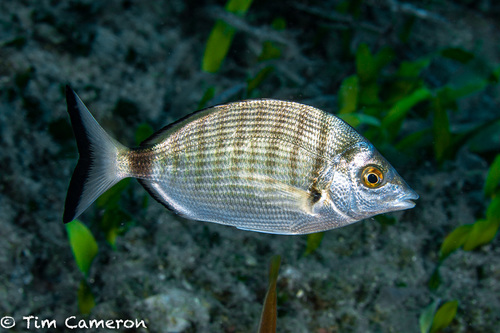
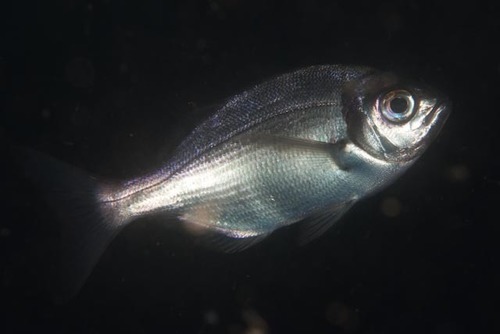
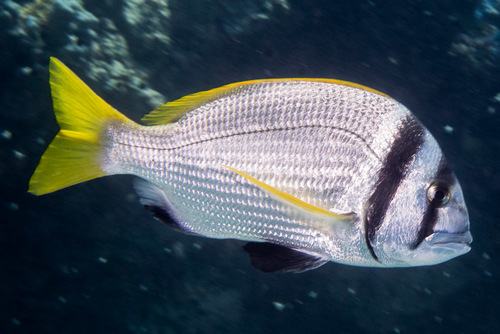
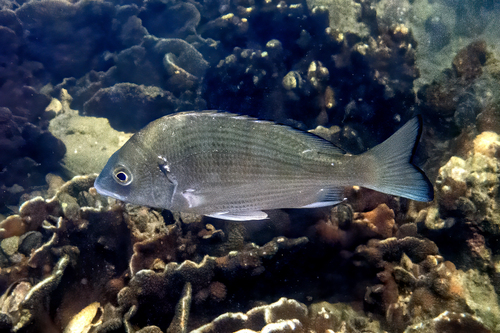
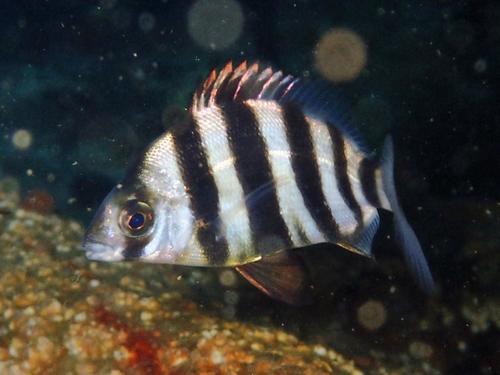
Diplodus hottentotus has a deep, oval, compressed body, where its body depth is 2 to 2.3 times its standard length. Its dorsal fin is supported by 11 spines and 12 or 13 soft rays, while the anal fin is supported by 3 spines and 11 soft rays. Pectoral fins have 15 fin rays each. The upper jaw has 10 or 12 incisor-like teeth at its front, and the lower jaw has 8 incisor-like teeth at the front. The species' body has a bright yellow background color, marked with 5 wide vertical dark bars along the back and flanks; its snout is black, and its gill cover is grey. All fins are grey, with the exception of juvenile individuals, which have a pink caudal fin with a black bar at its base. The maximum published total length recorded for this species is 60 cm (24 in), though a total length of 30 cm (12 in) is more typical. Diplodus hottentotus is distributed in the southwestern Indian Ocean, off the southern and eastern coasts of South Africa and southern Mozambique. A separate disjunct population exists in the southeastern Atlantic Ocean off Angola, and this population may be taxonomically distinct. This sedentary fish, commonly called the zebra, occurs in rocky habitats from the surf zone down to depths of 120 m (390 ft) in submarine canyons. Juveniles are also very sedentary, and inhabit shallow reefs below the low tide mark, gullies, tidal pools, and estuary mouths.