About Diplodus cervinus (Lowe, 1838)
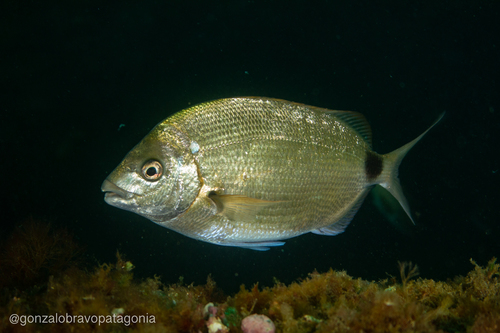
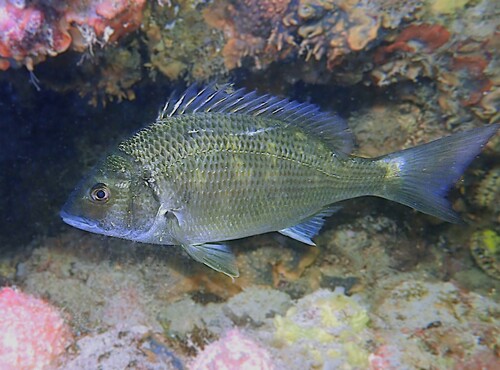
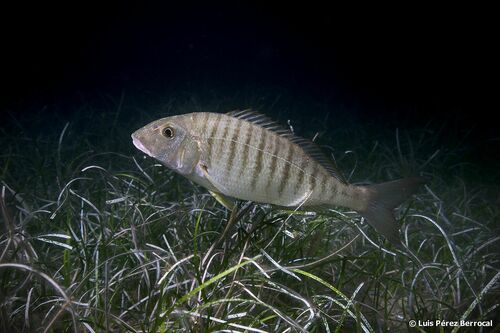
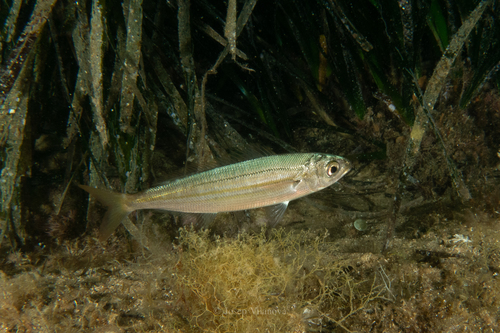
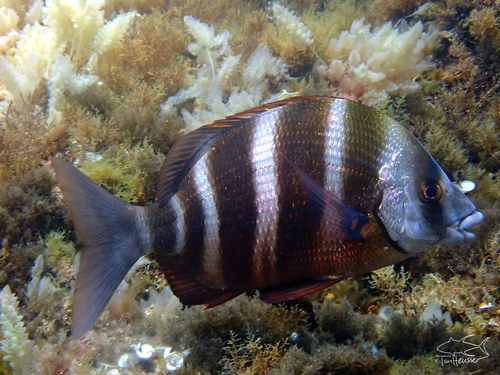
Diplodus cervinus has a deep, compressed, oval-shaped body, with a moderately sharp snout and a slightly protrusible mouth with thick lips. At the front of its upper jaw, there are 10 to 12 incisor-like teeth; the lower jaw has 8 incisor-like teeth. Behind these front teeth, there are between 1 and 3 rows of molar-like teeth, with 2 rows being the typical number. The dorsal fin is supported by 11 or 12 spines, which increase in height up to the fourth spine, and 11 to 14 soft rays. The anal fin is supported by 3 spines and 10 to 12 soft rays. The caudal fin (tail) is forked. Its base body color is silvery or golden grey, marked with 5 thick dark vertical bars on the upper body and flanks. It also has dark pigmentation around the eyes and cheeks, a dark tip on the snout, and a small dark spot at the upper base of the pectoral fin. The pelvic fins are dark, while all other fins are greyish, darkening toward their margins. The maximum published total length of this species, commonly called the annular seabream, is 55 cm (22 inches), though 35 cm (14 inches) is a more typical size. Its maximum published weight is 2.7 kg (6.0 lb). Diplodus cervinus occurs in the eastern Atlantic Ocean, ranging from the Bay of Biscay south to Mauretania. Its range includes the Canary Islands, Madeira, and the Cape Verde Islands, and extends into the Mediterranean Sea, but it is not found in the Black Sea. It is a benthopelagic species. It is found at depths of 30 to 80 m (98 to 262 ft) over rocky substrates, but can occur as deep as 300 m (980 ft) over sandy substrates.