About Diplodus capensis (Smith, 1844)
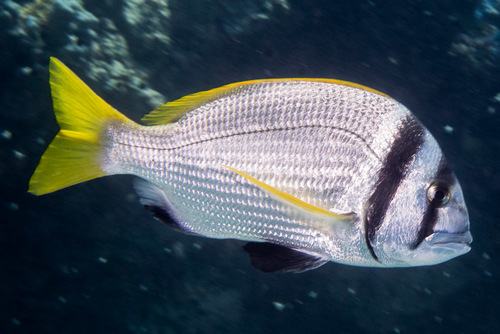
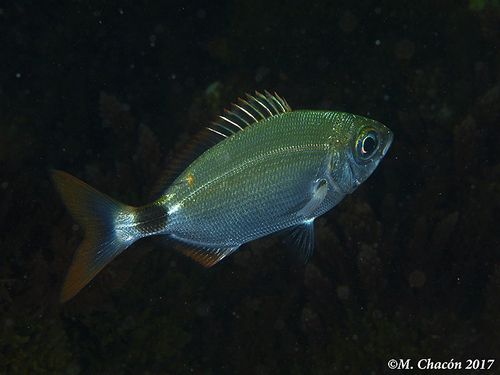
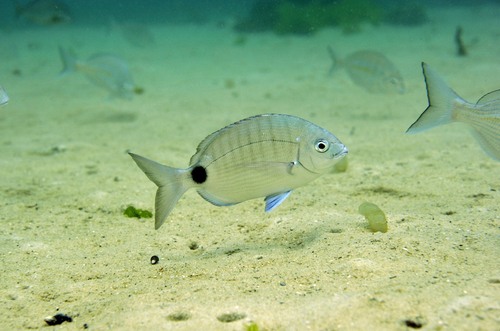
Diplodus capensis (Smith, 1844) has a deep, oval body with a thin-lipped, slightly protrusible mouth. Each jaw holds 8 incisor-like teeth at the front; the upper jaw has 3 rows of molar-like teeth, while the lower jaw has 2 rows. The dorsal fin is supported by 12 spines and 14 or 15 soft rays, and the anal fin is supported by 3 spines and 13 or 14 soft rays. Large adult individuals are a uniform silvery-grey, with a large, saddle-shaped black blotch on the caudal peduncle. Juveniles are marked with indistinct vertical bars. The maximum published total length for this species is 45 cm (18 in), though 30 cm (12 in) is a more typical size. Diplodus capensis is endemic to waters off Southern Africa, found in both the southeastern Atlantic and southwestern Indian Oceans. It has a disjunct distribution: one population lives off southern Angola and Namibia, and the other occurs from Cape Point east and north to southern Mozambique. It is also found off southern Madagascar, and has been reported from Mauritius. This species lives at depths between 0 and 50 m (0 and 164 ft). Adults live in shallow water over sandy and rocky substrates, while juveniles are found on shallow reefs, at estuary mouths, in tidal pools, and in the surf zone on sandy beaches.