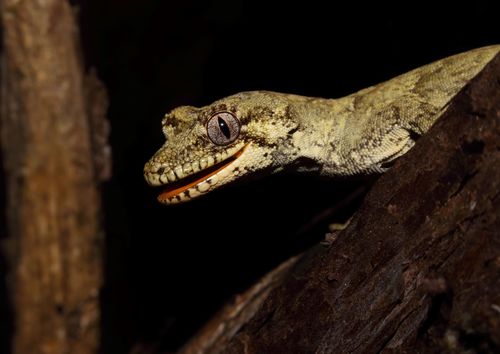
About Diplodactylus tessellatus (Günther, 1875)
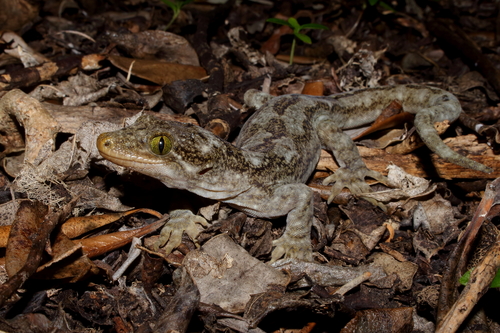
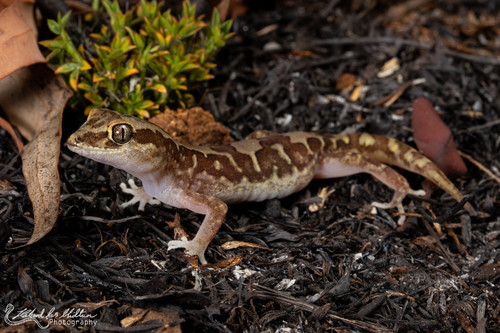
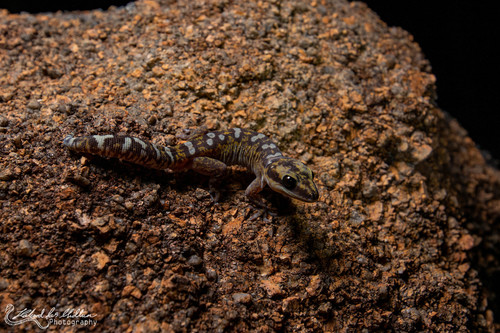
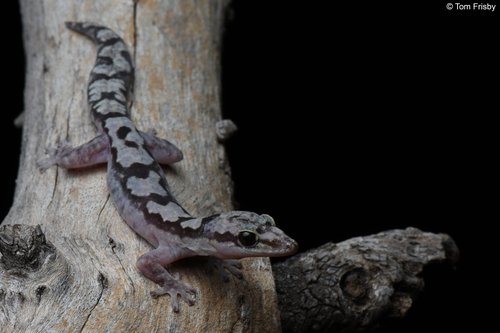
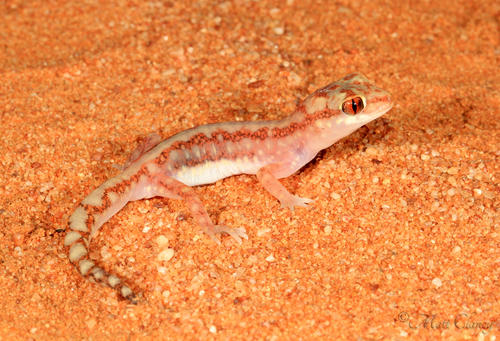
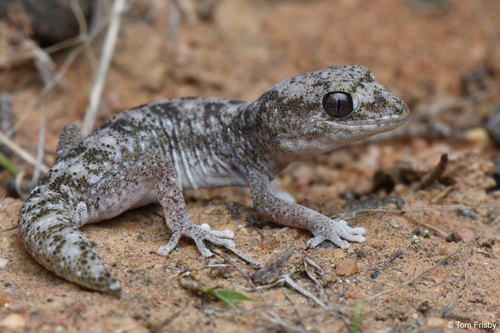
Morphology: Adult tessellated geckos (Diplodactylus tessellatus) average 9 cm in total length. They have a moderate-sized body, and a short fleshy tail marked with rings of enlarged conical scales. Their body colour ranges widely from pale grey to rich red, and their overall patterning is highly variable. An irregular series of pale yellow or blackish spots, often arranged in pairs, typically runs along the mid-dorsal region of the body and tail. Pre-anal pores are absent, and the species has 4 to 13 post-anal tubercles. Like other species in the genus Diplodactylus, tessellated geckos have slightly depressed, narrow, long digits. Males have a distinctive paracloacal spur positioned near the top of the hemipenal bulge, next to the hind limb. Hatchlings are typically more brightly coloured than adults, and measure 25 to 30% of the average adult size. Habitat and distribution: This is a terrestrial gecko, widely distributed across the arid interior regions of New South Wales, Queensland, the Northern Territory, South Australia, and Victoria. During the day, it rests in protected microhabitats including ground cracks, abandoned spider holes, rock crevices, under debris, or under fallen timber—all of which provide camouflage from predators. It emerges at night to feed on insects. It can be quite abundant in suitable habitat, such as the black soil floodplains of large inland rivers. Population & Ecology: From 1985 to 1987, Klaus Henle studied the life history and population ecology of this species in Kinchega National Park. Study results showed that the species experiences short peaks of high mortality in spring or summer, with low mortality for the rest of the year, particularly in winter when individuals are inactive or restricted in movement. Dispersal distances for individual geckos range from 50 to 100 meters from their birth site. They are active from September (the start of spring) through the end of May, before entering winter hibernation.