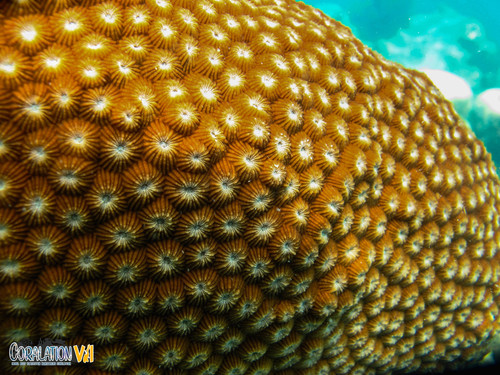
About Diploastrea heliopora (Lamarck, 1816)
Diploastrea heliopora (Lamarck, 1816) is a colonial coral species that grows into domes 1 metre (3 ft 3 in) or more across. Its corallites are plocoid, meaning each has an individual wall. They are round, closely packed, around 1 cm (0.4 in) in diameter, and formed through extratentacular budding. The corallite walls have a distinctive structure: they are not solid, and instead form from the enlarged outer ends of the septa, which are not connected to one another. The columellae of this coral are large, the overall surface is smooth, and the color is usually cream or greyish-brown, sometimes with a green tinge. It is a zooxanthellate species, hosting symbiotic dinoflagellates within its tissues that supply most of the nourishment it needs. Polyps extend their tentacles to feed to supplement this nutrition, and only do so at night. This species is widespread across the tropical waters of the Indo-West Pacific region, including the Red Sea. It occurs at depths down to 30 m (100 ft), and its typical habitat is silty environments without strong wave action, such as protected fringing reefs and back reef slopes. In the Indian Ocean's atoll lagoons, it is often plentiful and the dominant coral species, while it is uncommon in the Red Sea. Small gobies are often found perching on this coral or swimming across its surface to search for food.

