About Diplecogaster bimaculata (Bonnaterre, 1788)
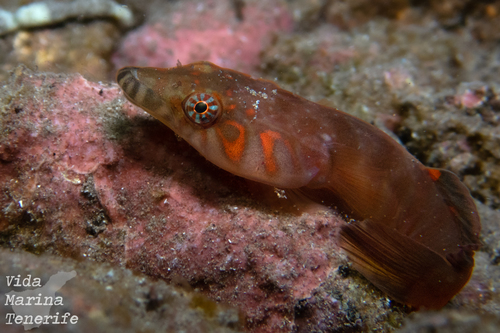
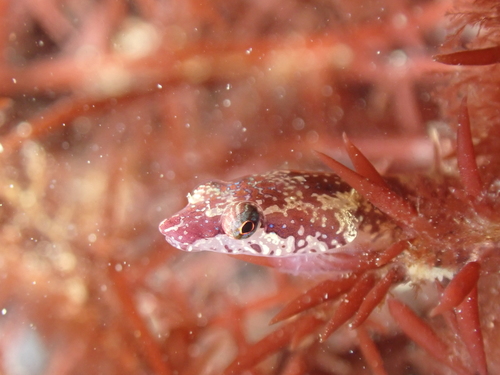
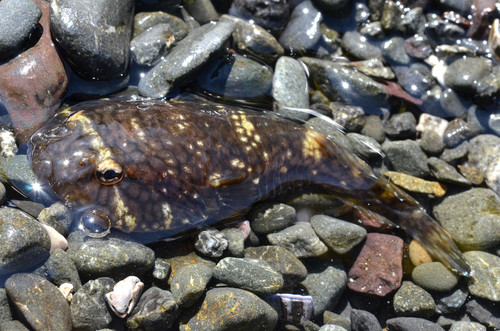
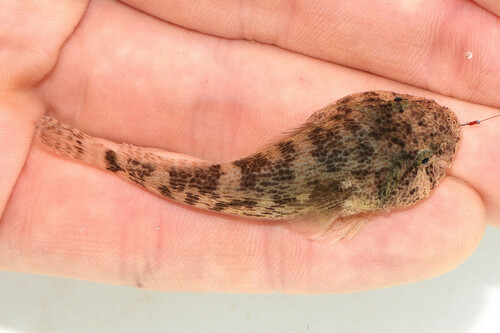
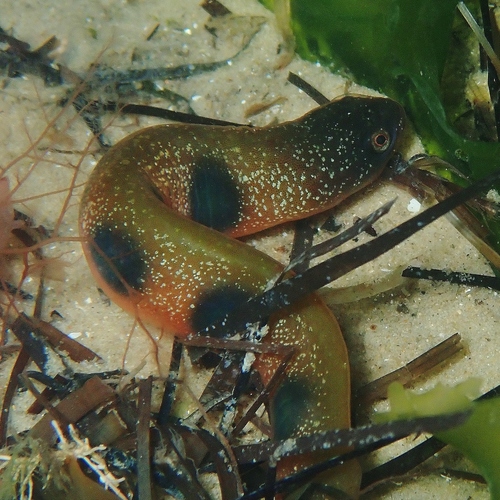
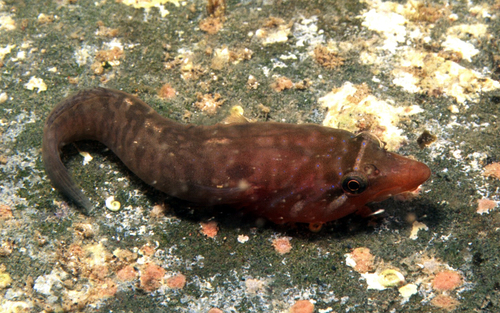
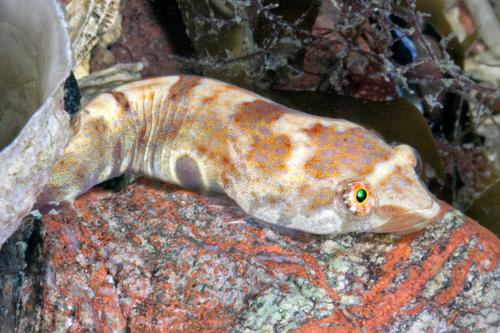
Diplecogaster bimaculata, the two-spotted clingfish, has pelvic fins modified into a sucker that it uses to cling to rocks and other hard surfaces. Its body colouration is variable; individuals are most often red, marked with spots of violet, blue, brown or yellow, and have a yellowish ventral surface. This species is sexually dimorphic: males have a purple spot surrounded by yellow located just behind their pectoral fin. It has a flattened body, a small roughly triangular head, large eyes, a short snout ending in large fleshy lips, and very small gill openings. This is a small fish that reaches a maximum total length of 6 centimetres (2.4 inches). Its single dorsal fin and single anal fin are positioned posteriorly near the tail, and both are separate from the caudal fin, which sits at the end of a long caudal peduncle. D. bimaculata can be confused with the closely related small-headed clingfish Apletodon dentatus; the two-spotted clingfish has a much more northerly range than A. dentatus, and the most reliable way to tell the two species apart is by their teeth. In D. bimaculata, teeth are small, conical, and grow in patches, with no large canine teeth present. Diplecogaster bimaculata is distributed in the northeastern Atlantic, ranging from Trøndelag in Norway and the Faroe Islands south to Gibraltar. Its range includes Madeira, the Azores, the Canary Islands, and the Mediterranean Sea extending east as far as the Adriatic Sea. Two-spotted clingfish most commonly occur on rocky substrates, but are also frequently found in seagrass beds and on bivalve banks. These habitats provide abundant empty mollusc shells that the fish use for shelter. The species occurs from the intertidal zone down to a depth of 55 metres (180 ft). It lays eggs during spring and summer; adult parents guard the egg mass, which is typically laid under a stone or inside an empty mollusc shell. Larvae and juvenile fish are pelagic, but quickly shift to a benthic lifestyle. The majority of its diet consists of small crustaceans. It has been photographed cleaning the Mediterranean moray, Muraena helena.