About Diphyllodes magnificus (J.R.Forster, 1781)
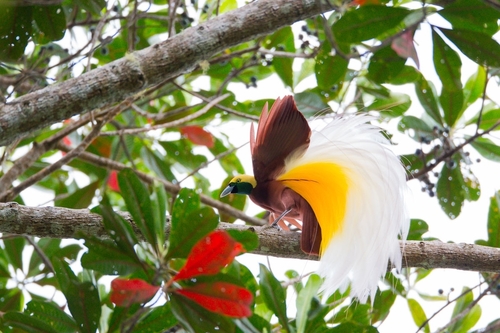
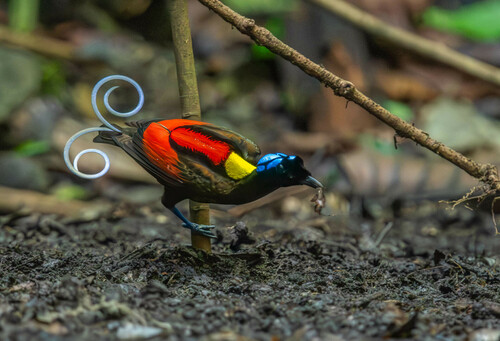
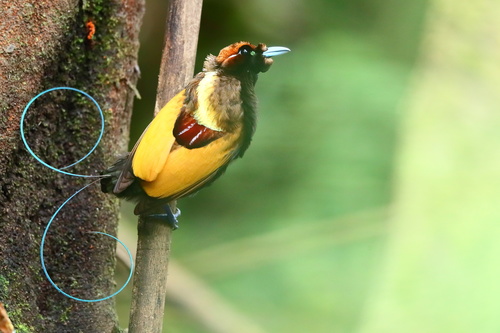
The magnificent bird-of-paradise, scientific name Diphyllodes magnificus (J.R.Forster, 1781), has one of the most complex plumage arrangements within the bird-of-paradise family Paradisaeidae. It reaches a total length of around 26–26.5 cm, while its body alone measures around 19 cm. The male has striking golden-yellow wings, overlapped by a sulfur-colored mantle, or cape, that gives off a whitish glow. Beneath the cape, deep red feathers bordered in black form a semicircle over the wings, and scruffy brownish feathers grow along the sides of the cape. The male has a fairly short head: the top of the head and the back of the neck are light brown with a scalloped pattern, while the face and area below the chin are a darker reddish-brown. It has a pale grey-bluish bill, dark brown eyes, and a thin white line that extends behind each eye. The male's underside is very distinct: almost the entire underside is covered by a large, iridescent green breast shield finely decorated with lime-green to turquoise scale-like feathers that run down the shield's middle. The plumage under the breast shield is blackish-brown, and when the shield is fully extended, its edge is shiny turquoise-greenish. The tail is blackish-brown, with two long, sickle-like, partially curved central tail plumes that are colored light blue. As is characteristic for members of the genus Cicinnurus, both sexes have distinctly blue legs and feet. The female plumage is drastically different from the male's elaborate plumage. The female is light-brown on her upper side including her tail, and she lacks the male's long sickle-shaped tail plumes. Her head is light brown, but her chin through to the rump has brown barring over creamy feathers. Her bill is the same color as the male's, and she also has a white line extending behind her eyes. This species is sympatric with its congener the King Bird-of-paradise, and hybridization between the two has been recorded multiple times. More than 20 specimens of these hybrids are held in museums, but no hybrid individuals have ever been recorded in the wild. The hybrid was once even classified as a separate species called King of Holland's Bird-of-paradise, under the scientific name Diphyllodes gulielmitertii. This hybrid has the scarlet red upper body of the King Bird-of-paradise, combined with the golden mantle cape of the Magnificent Bird-of-paradise. It also has two long tail wires that more closely resemble the King's, with partial curvature at the tip and no green spirals that mark the King's tail wires. This rather common species has a large, widespread distribution across Indonesia, New Guinea, and the surrounding islands. It inhabits tropical and subtropical montane and hill forests, most commonly at an altitude of around 1500 m, though it can also be found at altitudes up to around 1780 m.