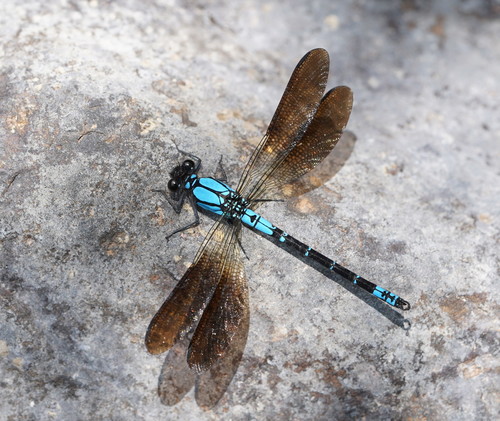
About Diphlebia coerulescens Tillyard, 1913
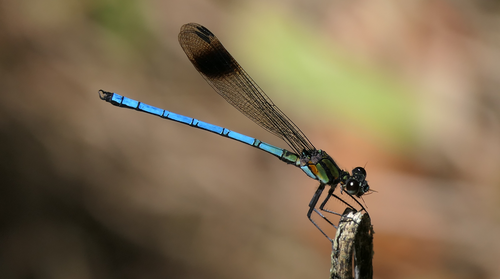
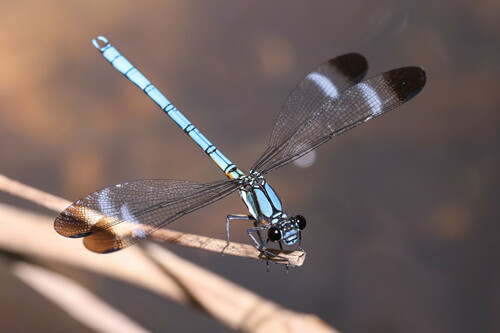
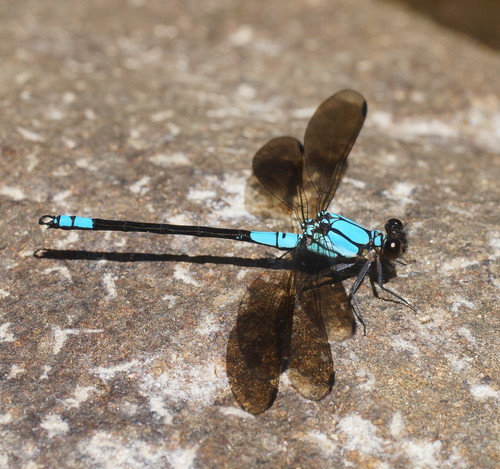
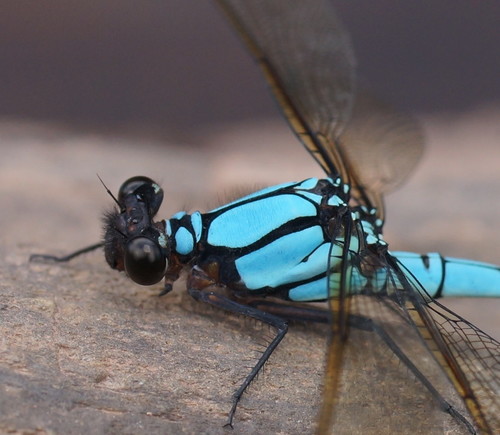
Diphlebia coerulescens, commonly called the sapphire rockmaster, is an Australian species of broad-winged damselfly. It belongs to a group of damselflies known as the azure damselflies. This species is distributed across Queensland and north-eastern New South Wales in eastern Australia, where it inhabits fast-flowing streams and rivers. English-born entomologist Robin Tillyard first described the sapphire rockmaster as a subspecies of the tropical rockmaster, Diphlebia euphaeoides, in 1913. He later reclassified it as a separate species, based on the distinct shape of the male anal appendage, alongside differences in adult size and colour. Male sapphire rockmasters have a body that is mostly bright blue and black, with dark wings. This species can be told apart from the tropical rockmaster by the larger size of two prominent blue markings located at the base, or front end, and underside of the fourth to sixth abdominal terga. The upperside of its otherwise black abdomen often has blue markings on the front ends of each tergum. Its wings are narrower than those of the tropical rockmaster, but wider than the wings of other members of the Diphlebia genus; the wings are smoky brown rather than black. The legs are mostly brownish black, with blue colouring present on the upper sections of the mid and hind femurs. Female sapphire rockmasters are predominantly brown and olive-green, and also have smoky-coloured wings. Their legs are dark brown, with light brown colouring on the upper segments of the mid and hind femurs. The upperside of the female abdomen is dark olive-green, with a prominent darker dorsal line running down the midline. This line widens into a roughly triangular shape at the rear end of each abdominal segment, called the tergum.