About Diphasium scariosum (G.Forst.) Rothm.
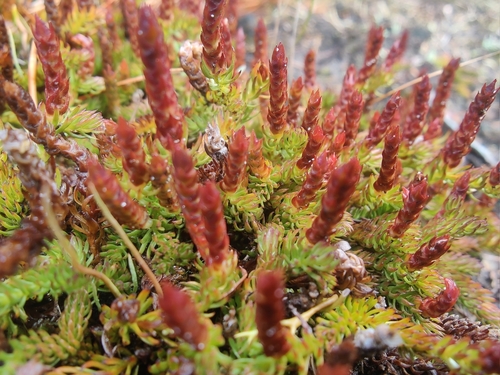
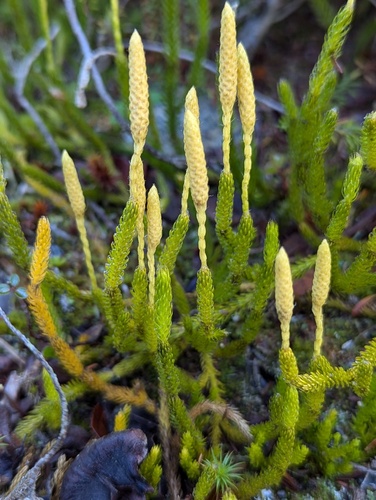
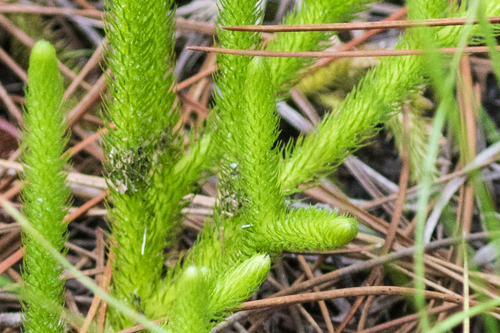
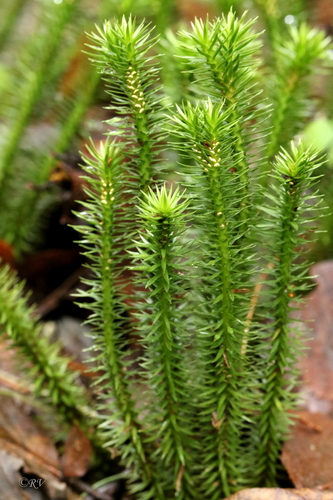
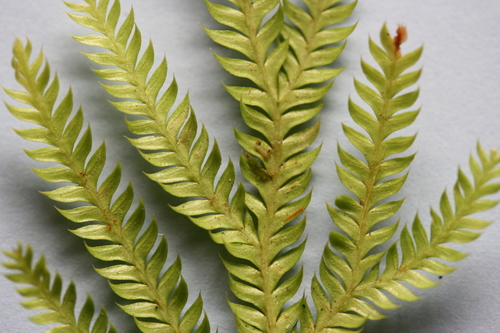
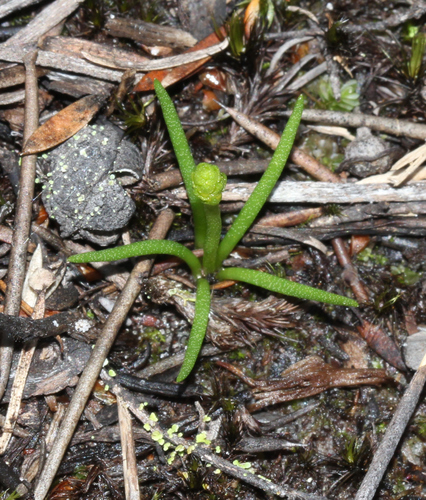
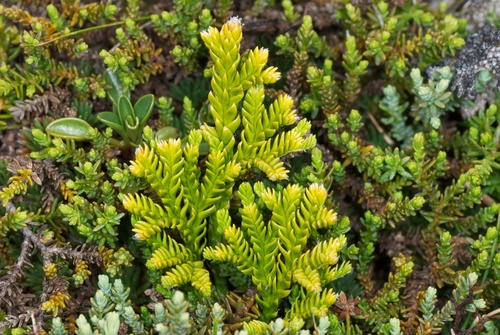
Diphasium scariosum (G.Forst.) Rothm. has main stems that grow prostrate along the ground, spreading to over 1 meter in length. Its very branched branchlets reach 0.5 m tall and have two distinct surfaces. The species has dimorphic, yellowish-green leaves. The first leaf type forms on the upper part of the plant, arranged in two alternating rows and flattened into a single plane; these upper leaves are oval, 3–5 mm long and 1–1.5 mm wide. The second leaf type occurs on the lower part of the plant, arranged in two rows but not flattened into a single plane; these lower leaves are scale-like, only 0.2 mm long, and have translucent, membranous, expanded tips. D. scariosum has distinctive colouration, with large fluorescent spots spread throughout its tissues. This feature is unusual for a club moss, because few club moss species contain 5-O-glucosides of flavones, the compound that causes these bright fluorescent spots. D. scariosum produces solitary, erect strobili that grow 1–3 cm long. Its sporophylls overlap one another, are oval, straw-coloured, and have membranous tips. As a member of the Lycopodioideae subfamily, Diphasium scariosum differs from genera belonging to the Lycopodielloideae sensu in that it has pedunculate strobili containing modified sporophylls. Diphasium scariosum occurs naturally across the globe in the Philippines, New Guinea, Borneo, Australia, New Zealand, and the Subantarctic islands. Within New Zealand, it is found throughout the North Island, though it is less common in Northland, and also occurs throughout the South Island. This species grows in coastal to subalpine environments, on mossy roadside banks, in shrubland, and on peaty ground. It prefers well-drained clay or peaty soils. Diphasium scariosum is a pteridophyte. After spores are released from the sporophylls and strobili, they can take seven or more years to develop into a gametophyte, which can then survive for 10 or more years. The full lifecycle of a Lycopodium species can take up to 20 years to complete. D. scariosum reproduces sexually under unfavourable growing conditions, and asexually under favourable conditions. When it is not producing spores, it grows laterally along the ground.