About Diphasiastrum tristachyum (Pursh) Holub
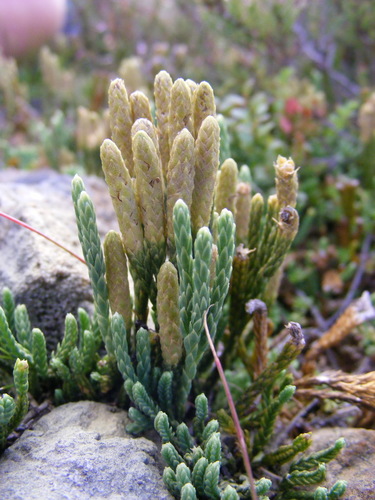
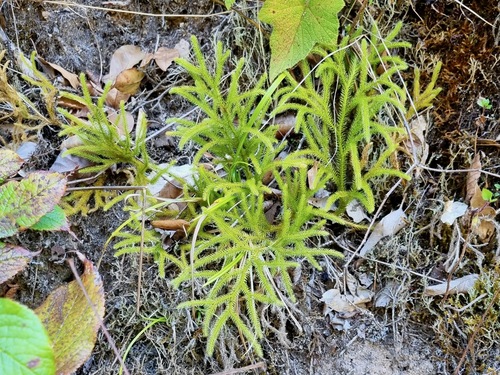
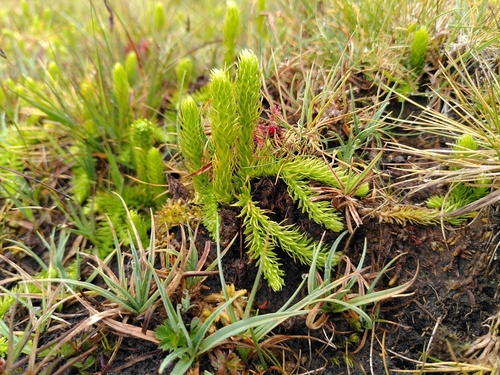
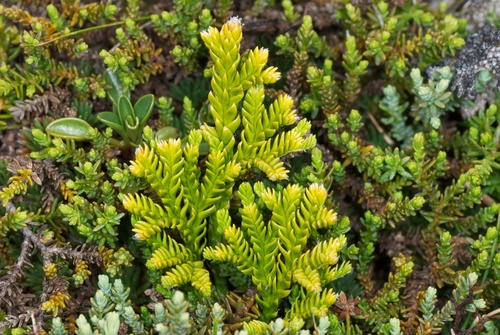
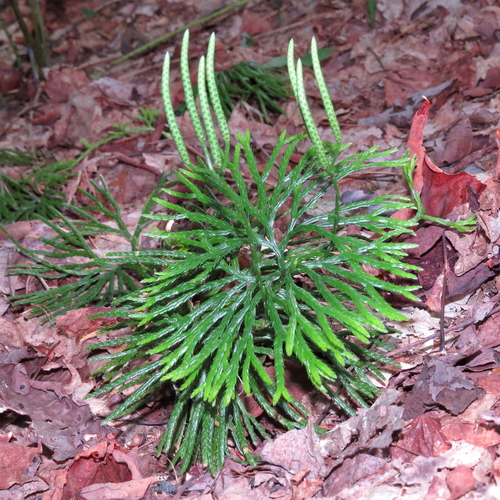
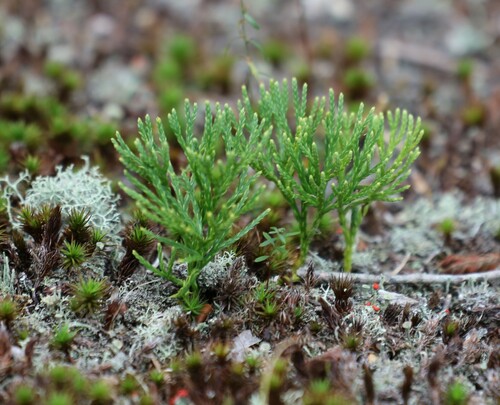
Diphasiastrum tristachyum, also commonly called ground cedar, is a perennial clubmoss species. It grows from creeping underground stems that are often deeply buried, between 5 and 12 centimeters below the surface. Above-ground stems emerge from nodes on these underground stems. Upright stems may reach 30 centimeters (12 inches) in height or grow taller. What appear to be several fan-shaped leaves on the main stem are actually branched stems that resemble leaves; each of these branched stems branches 4 to 6 times. All of these stems grow to a similar height at the top of the plant, giving it a flat-topped form that is a defining diagnostic feature for this species. The peduncle is roughly 9 centimeters long, and often branches twice near its top to form four strobili. The strobili are around 6 centimeters long, 3 to 4 millimeters in diameter, and have a rounded tip. Each strobilus contains sporophylls that measure 2.2-3.5 mm by 1.6-3 mm; these sporophylls are light yellow, deltoid-shaped, and have a long sharp pointed tip, with rough, chaffy edges. The spore case is nearly round, and the spores themselves are convex along their sides. In cross-section, the branches are 1-2.2 mm wide and square with rounded angles. The blue-green actual leaves are scale-like, arranged in four ranks, and range from lanceolate to subulate in shape. This species can be told apart from similar related species by annual constrictions along these branches. Ground cedar grows best in dry, sandy areas with poor nutrients, allowing it to grow in barrens and other dry xeric sites. It can tolerate the sterile, acidic soils that often occur in coniferous forests. Ground cedar also prefers to grow in open areas where other plants do not grow densely. Plants that grow in shade have more spread-out branching than plants that grow in full sun, but its branchlets are always more rounded than the branchlets of either D. complanatum or D. digitatum.