About Diphasiastrum digitatum (Dill. ex A.Braun) Holub
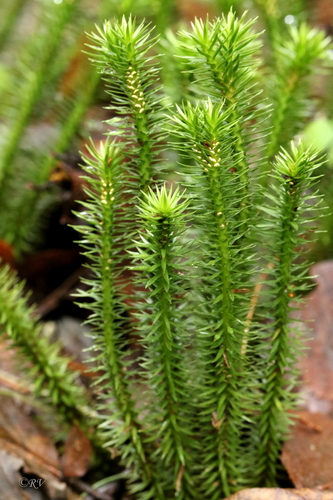
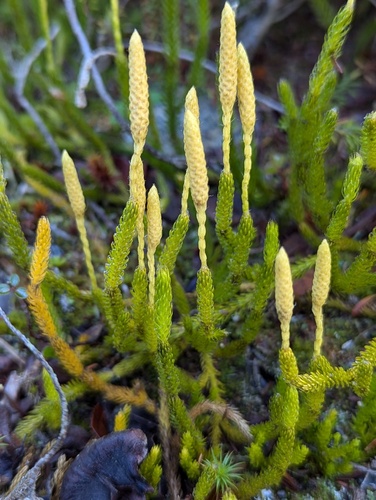
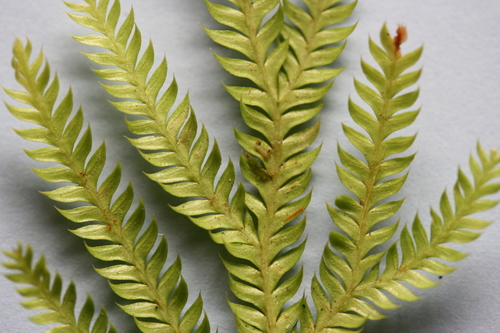
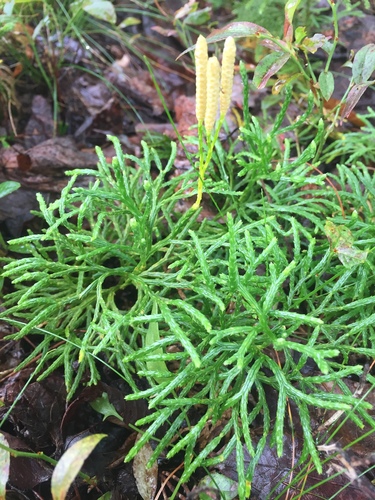
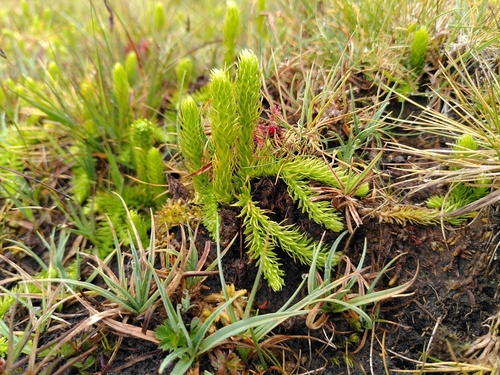
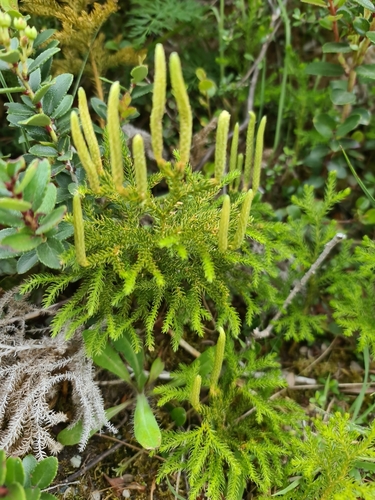
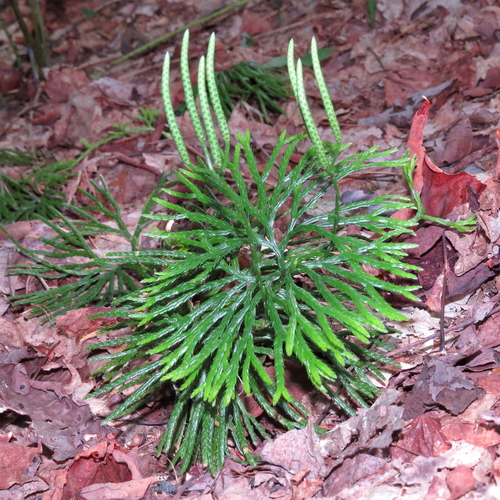
Diphasiastrum digitatum is a perennial vascular plant with no significant amount of woody tissue above or at ground level. It is low-growing, usually reaching less than 30 cm in height. Its leaves are evergreen; they appear opposite, are arranged in a spiral with four evenly spaced leaves, and look like four columns when viewed from the side. Branch leaves are green and shiny, with a base that extends down onto the stem (a trait called decurrent), and a pointed, scale-like free portion at the tip. Branches are rectangular in cross-section, flattened on the underside, and the leaf associated with the underside is much smaller than other leaves. The largest leaves are located on the sides of the branch; their free portion lies pressed against the branch to spreading out from it. Leaves on the upper branch surface are pressed against the branch and narrower than other leaves. Stems grow horizontally either above ground or just below the surface of the forest duff layer. Each erect shoot has two or more branches near its base. Branches are most often ascending to spreading, forked and tree-like, and usually arranged in the same plane in a fan shape. Erect shoots can measure from 3 to 20 inches tall, though vegetative shoots are typically less than 8 inches tall. Spores develop in cone-like structures called strobili. Usually 2 to 4 strobili (rarely more) cluster at the tip of a long stalk called a peduncle. Diphasiastrum digitatum grows in dry to mesic, typically acidic forests and open areas in eastern North America, ranging from the Canadian provinces of Ontario and Quebec south to Florida and Louisiana. It most commonly occurs in partially shaded habitats that are moist to dry, and can be found in open forest, thickets, fields, upland woodlands, bluffs, sandstone cliffs, and abandoned sandy fields. It is often found in wooded areas that also contain oak trees and conifers. Its spore-producing season runs from July to October. This species has medicinal, pyrotechnic, and decorative uses. Since ancient times, club moss spores and teas made from its leaves have been used by both American Indian and European cultures. Medicinal uses have included treating urinary tract problems, diarrhea and other digestive tract issues, relieving headaches and skin ailments, and inducing labor during pregnancy. In some cultures, spores have been claimed to work as an aphrodisiac. Because spores repel water, they have been used as a powder for skin rashes, baby bottoms, and to treat wounds. Historically, spores have also been used as a coating for pills and as a fabric dye in both Europe and the Americas. Spores are highly flammable due to their high oil content. They have been used for ceremonial purposes, when medicine people tossed spores into a fire to create a flash of light. Because they ignite with a bright flash of light, spores have also been used in flash photography, stage productions, fireworks, and chemistry laboratories. Today it is mainly used for bladder disorders, kidney disorders, and other conditions, though more evidence is needed to confirm its effectiveness and safety. Diphasiastrum digitatum is very difficult to cultivate in home gardens, and transplants are rarely successful. Growing mature plants from spores is very slow, possibly taking up to 20 years. It can be grown in greenhouses, growth chambers, and laboratories with frequent applications of weak fertilizer solution, under bright light, high humidity, and year-round moderate temperatures. During its sexual phase, this species grows underground and requires the presence of specific compatible fungi to survive. It prefers somewhat acidic, sandy or rocky, well-drained soil, and dappled sunlight to light shade.