About Diospyros kaki L.f.
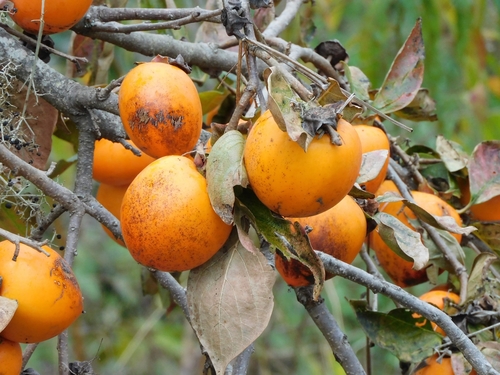
Diospyros kaki, commonly called the Oriental persimmon, Chinese persimmon, Japanese persimmon, kaki persimmon, or Fuyu persimmon, is the most widely cultivated species in the genus Diospyros. While its first formal botanical description was not published until 1780, cultivation of D. kaki in China stretches back more than 2000 years. Diospyros kaki is grown across the world, and 90 percent of the global total production comes from China, Japan and Korea. In East Asia, the main harvest falls in October and November. By the time of harvest, the trees have already lost all their leaves. Occasionally, the brightly colored fruit is left unharvested on the tree to serve as decoration. Cultivation of this species first spread across East Asia. Starting in the 19th century, Diospyros kaki partially replaced the date-plum (Diospyros lotus, also known as Caucasian persimmon) in some South European and West Asian countries, because D. kaki produces larger fruits than the date-plum. Cultivation of D. kaki in California also began during this century. The name "Sharon" is a trade name for the "Triumph" variety, which is grown in the fertile Plain of Sharon in Israel. This is a pollination-constant astringent (PCA) variety, which is always treated with carbon dioxide (CO2) gas to remove astringency before being marketed. This variety has a distinctly squarish shape and one of the highest sugar contents of any D. kaki variety. Unlike most other varieties, it has very firm skin, which gives it good storage life and good resistance to damage during handling. In Spain, the most prominent commercial variety is Rojo Brillante. This is also a PCA variety, grown mostly in the Valencia region in a protected designation of origin (DOP) area called Ribera del Xuquer. Over the last decade, a CO2 treatment process has been perfected that allows nearly all Rojo Brillante fruit to be treated to remove astringency, while retaining the fruit's firmness and storage qualities. This treated fruit is sold under the name "Spanish Persimon" (spelled with a single 'm'). Thanks to this treatment, the Rojo Brillante variety has become an easy-to-eat fruit that is highly popular internationally, and production of the variety has increased. In Italy, the most widely grown variety is the PCA variety Tipo, with other varieties grown in smaller volumes. Italy was formerly the largest exporter of Diospyros kaki in Europe, but Italian exports have dropped significantly as exports from Spain have taken over the market. Diospyros kaki is also produced in Albania, primarily in the Elbasan region. Since 1935–1940, it has also been grown in small quantities in Bulgaria, particularly in the Upper Thracian Plain and along the Bulgarian Black Sea Coast. In astringent D. kaki cultivars, the fruit has a high content of proanthocyanidin-type tannins that make unripe fruit astringent and bitter. Tannin levels decrease as the fruit matures. Fruit from these astringent cultivars is not edible when it is still crisp and firm; it is only edible once it becomes soft and fully ripe. Ripe fruit from astringent cultivars has a soft, jelly-like texture. The Japanese cultivar 'Hachiya' is a widely grown astringent variety. Other cultivars, such as 'Fuyu', do not contain tannins when they are firm. These non-astringent cultivars can be eaten crisp like an apple, or allowed to ripen to any stage, including the soft jelly-like ripeness stage. However, these non-astringent varieties are generally considered to have a less complex flavor.