About Dioscorea polystachya Turcz.
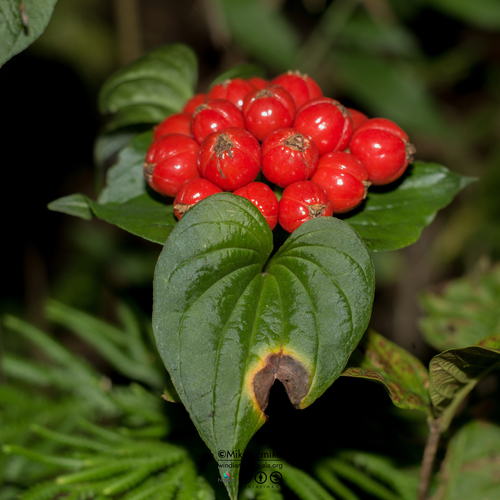
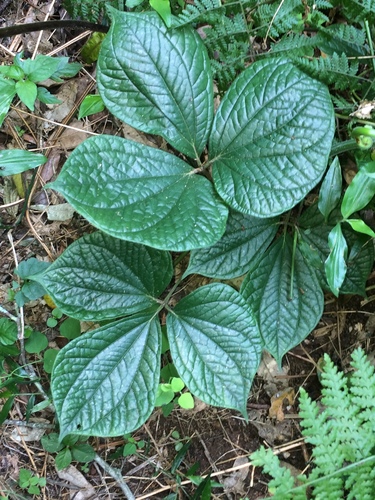
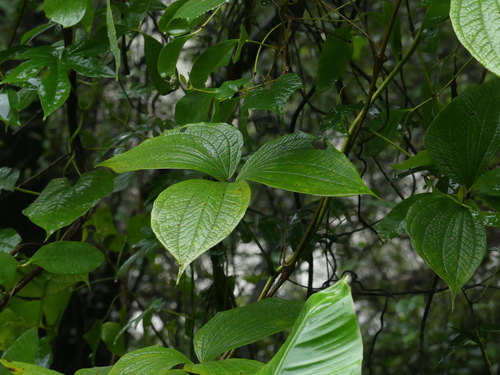
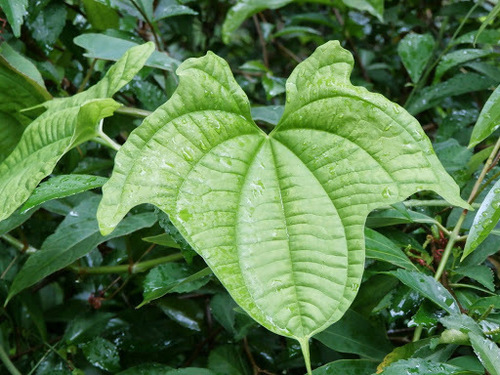
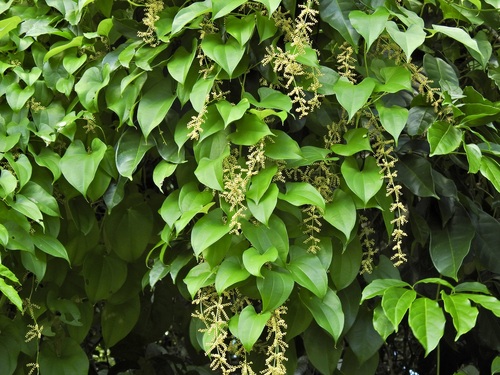
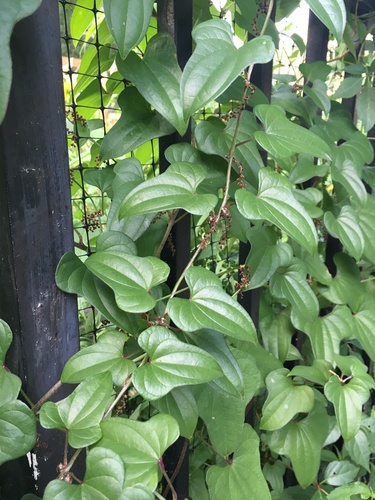
Dioscorea polostachya Turcz., commonly known as Chinese yam, is a vining plant with the following characteristics. Its vines typically reach 3 to 5 meters (9.8 to 16.4 ft) in length, and may grow even longer. All vines twine anticlockwise. Its leaves can grow up to 11 centimeters (4.3 in) in both length and width, with lobed bases; larger leaves may also have lobed edges. Leaf arrangement on the vine is variable, occurring as alternate, opposite, or in whorls. Warty, rounded bulbils under 2 centimeters (0.79 in) long grow in the plant's leaf axils. These bulbils are sometimes informally called "yam berries" or "yamberries", and new plants can sprout from whole bulbils or fragments of bulbils. The flowers of this species carry a cinnamon scent. The plant produces one or more spindle-shaped or cylindrical tubers. The largest tubers can weigh 10 pounds (4.5 kg) and grow one meter (3 ft 3 in) deep underground. Dioscorea polystachya is more tolerant of frost and cooler climates than other yams, a trait that has helped it successfully establish populations after introduction on many continents. The plant is native across East Asia. It is believed to have been introduced to Japan by the 17th century or earlier. It was introduced to the United States as early as the 19th century for culinary and cultural uses, and is now classified as an invasive plant species there. It was brought to Europe in the 19th century during the European Potato Failure, and continues to be cultivated in Europe today to supply contemporary East Asian food markets. In alternative medicine contexts, creams and dietary supplements made from the related species Dioscorea villosa are claimed to contain human hormones, and are promoted as treatments for a range of uses including cancer prevention, and treatment of Crohn's disease and whooping cough. The American Cancer Society states these claims are false, and there is no evidence to support that these substances are either safe or effective. Dioscorea polystachya, called huáishān, has also been used in traditional Chinese medicine. For culinary use, the tubers of D. polostachya can be eaten raw when grated or sliced, unlike most other yams which require cooking before consumption due to harmful substances in their raw state. Before use, the tuber skin must be removed by peeling, or scraping off with a hard-bristled brush. Peeling can cause mild hand irritation, so wearing latex gloves is advised; if itching occurs, lemon juice or vinegar can be applied to the affected area. Peeled whole tubers are briefly soaked in a vinegar-water solution to neutralize irritant oxalate crystals from the skin and prevent discoloration. The raw tuber is starchy, bland, and mucilaginous when cut or grated. It can be served plain as a side dish, added to noodles, or used in other preparations. Cultivation of Chinese yam has an approximately one-year growing cycle, and planting takes place between winter and spring. Traditional growing methods use small whole tubers, the top cut portion of larger tubers, or branch cuttings as planting material. The first two methods produce tubers that are 20 cm (7.8 in) long or longer. Branch cuttings produce smaller tubers, around 10 cm (4 in) long, that are usually replanted the following year. Between 7 and 9 months after replanting, the leaves of Chinese yam plants begin to dry out, which is a common indicator of tuber maturity in root and tuber crops that signals the tubers are ready for harvest. In home gardens, generally only the amount of tubers that will be consumed immediately is harvested, leaving the remainder stored in moist soil in the planting pot. The tubers themselves are not frost-hardy.