About Dioscorea communis (L.) Caddick & Wilkin
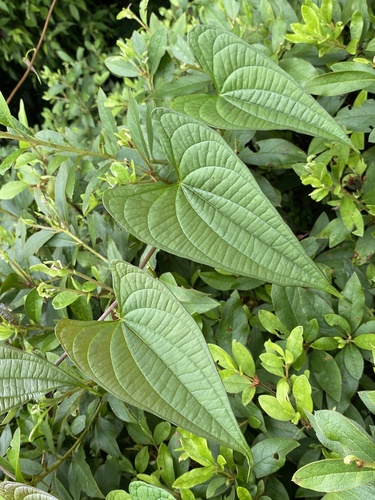
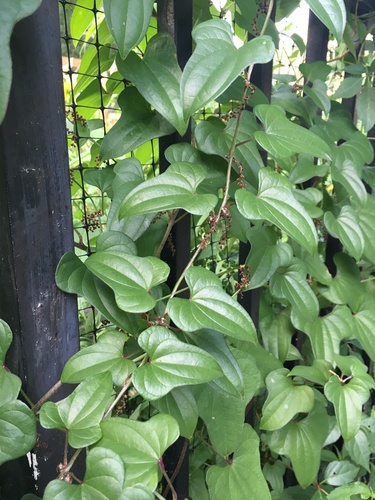
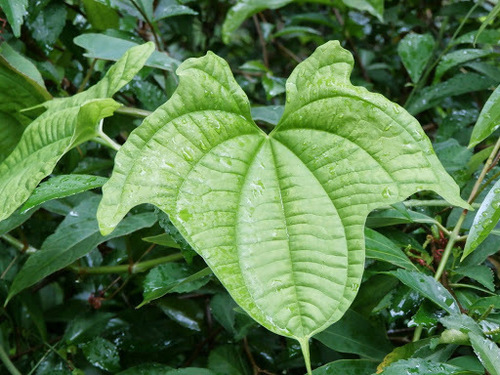
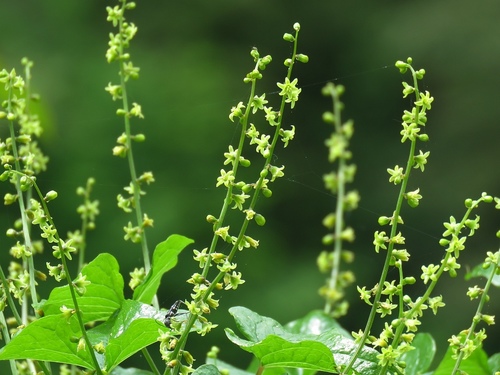
Dioscorea communis is a climbing herbaceous plant that grows 2 to 4 meters (6.6 to 13 feet) tall, with stems that twine anticlockwise. Its leaves are arranged spirally, are heart-shaped, and reach up to 10 cm (3.9 in) long and 8 cm (3.1 in) wide, with a petiole that grows up to 5 cm (2.0 in) long. This species is dioecious, meaning male and female flowers grow on separate individual plants. The individual flowers are inconspicuous, greenish-yellow, and 3 to 6 mm in diameter, with six petals. Male flowers grow in slender racemes 5 to 10 cm long, while female flowers grow in shorter clusters. The fruit is a bright red berry 1 cm in diameter. It produces a fairly large tuber, and like all other parts of the plant, the tuber is poisonous. Like most examined Dioscorea species, D. communis has extrafloral nectaries located on the petiole or the underside of its leaves. Dioscorea communis is native and widespread across southern and central Europe, northwest Africa, and western Asia, ranging from Ireland to the Canary Islands, and east to Iran and Crimea. This plant is a typical understory species found from sea level up to mountain elevations, most often growing in dense woods, but it can also occur in meadows and hedges. All parts of the black bryony plant, including the tubers, are poisonous because they contain saponins, so it is not generally used internally. The only reported exception is young shoots, which are harvested when their saponin content is still low and eaten as a vegetable. The plant has been used topically as a poultice to treat bruises and inflamed joints. It is recommended that black bryony be used topically with caution, as the plant can cause painful blisters. Studies have isolated calcium oxalate deposits and histamines in the plant's berry juice and rhizomes, and these compounds may contribute to the skin irritation and contact dermatitis linked to black bryony.