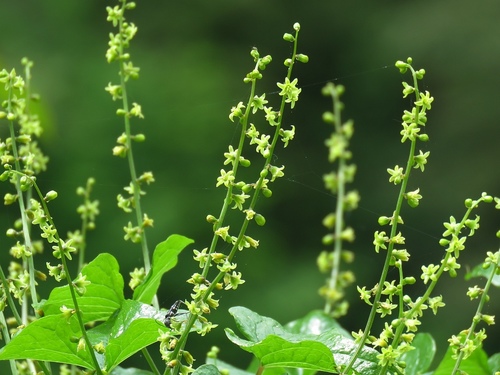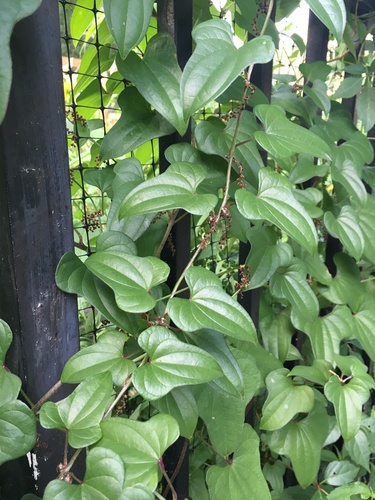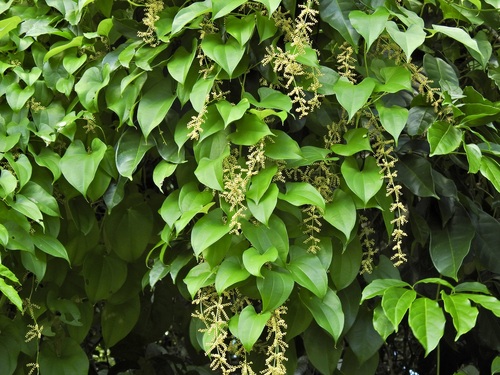
About Dioscorea alata L.
Dioscorea alata L., commonly known as ube, ubi, uwhi, purple yam, or greater yam (among other common names), is a species of yam grown for its edible tubers. Its tubers are typically a vivid violet-purple to bright lavender, which gives it the common name purple yam, though some cultivars produce tubers that range from creamy-white to plain white. It is sometimes confused with taro and the Okinawan sweet potato beniimo (Ipomoea batatas 'Ayamurasaki'), but D. alata is also grown in Okinawa. The species is native to the tropics of Asia and Oceania, and some varieties can grow to very large sizes; one example called the "Mambatap" greater yam, grown in Maprik, East Sepik District, Papua New Guinea around 1939, reached 3.5 m (11 ft) in length. Though D. alata is sold as a dietary supplement and used in folk medicine, there is no clinical evidence that it has any therapeutic properties. Consumption of D. alata supplements may cause adverse effects for people taking estrogens or anticoagulant drugs, as well as for people who are pregnant or breastfeeding. Some people may also experience allergic reactions to D. alata supplements. D. alata contains relatively high levels of oxalates, between 486 and 781 mg per 100 g of dry matter; oxalates are linked to antinutritional effects and kidney stone formation. Dioscorea alata is one of the most important staple crops in Austronesian cultures. It is among several yam species that were domesticated and cultivated independently in Island Southeast Asia and New Guinea for their starchy tubers, alongside the round yam (Dioscorea bulbifera), ubi gadung (Dioscorea hispida), lesser yam (Dioscorea esculenta), Pacific yam (Dioscorea nummularia), fiveleaf yam (Dioscorea pentaphylla), and pencil yam (Dioscorea transversa). Of these species, only D. alata and D. esculenta were regularly cultivated and eaten. The rest are usually only used as famine food, since they contain higher levels of the toxin dioscorine and require special correct preparation before consumption. D. alata is cultivated more widely than D. esculenta, mostly because it produces much larger tubers. D. alata and D. esculenta were well-suited for long-distance transport on Austronesian ships, so they were carried across nearly the entire range of the Austronesian expansion. In particular, D. alata was introduced to the Pacific Islands and New Zealand, and also brought by Austronesian voyagers to Madagascar and the Comoros. While the center of origin of purple yam is recognized as the Philippines, archaeological evidence indicates that the species was already exploited in Island Southeast Asia and New Guinea before the Austronesian expansion. Purple yam is widely believed to be a true cultigen, only known to exist in cultivated forms. The vast majority of its cultivars are sterile, meaning it can only spread to new islands through human activity, which makes it a useful indicator of prehistoric human movement. Some authors have proposed an origin in Mainland Southeast Asia, but this claim has no supporting evidence, and the species shows the greatest phenotypic diversity in the Philippines and New Guinea. Based on archaeological evidence from early farming plots and plant remains recovered at the Kuk Swamp site, some authors suggest that D. alata was first domesticated in the New Guinea highlands around 10,000 years before present, then spread into Island Southeast Asia via the Lapita culture around 4,000 years before present, alongside D. nummularia and D. bulbifera. In contrast, D. esculenta is thought to have been introduced to New Guinea by the Lapita culture. There is also evidence of an agricultural revolution during this period, driven by innovations from contact with Austronesians, including the development of wet cultivation. However, much older remains likely belonging to D. alata have been recovered from the Niah Caves of Borneo (Late Pleistocene, less than 40,000 years before present) and the Ille Cave of Palawan (around 11,000 years before present), alongside remains of the toxic ubi gadung (D. hispida), which requires processing before it can be eaten. While these finds do not prove that D. alata was being cultivated at the time, they do show that humans already had knowledge of how to exploit starchy plants, and that D. alata was native to Island Southeast Asia. These finds also leave open the question of whether D. alata is a true species, or if its cultivation began much earlier than commonly thought. Purple yam remains an important crop in Southeast Asia, especially in the Philippines, where the vividly purple variety is widely used in many traditional and modern desserts. It is also still important in Melanesia, where it is grown for ceremonial events that center on the size of harvested tubers. However, its importance in eastern Polynesia and New Zealand has declined after the introduction of other crops, most notably the sweet potato. The purple color of purple varieties of D. alata comes from various anthocyanin pigments. These pigments are water-soluble, and have been suggested as a potential natural food coloring agent. D. alata is also sometimes grown in home gardens for its ornamental value.