About Diopatra cuprea (Bosc, 1802)
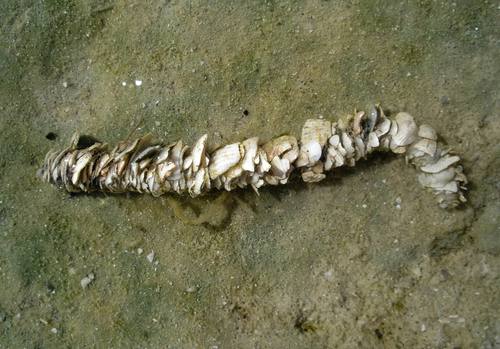
Diopatra cuprea lives in a parchment-like tube constructed from mucous polysaccharide material. Most of the tube is buried in sediment, while its tip protrudes above the sediment surface. The tube functions like a chimney; the buried lower section can reach up to one metre in length, is smooth and has sediment grains adhering to its surface. The exposed upper section is shaped like an inverted J, and its outer surface is reinforced with shell fragments and small pebbles cemented in an overlapping mosaic pattern. If increased siltation threatens to bury the tube, the worm extends this upper section, and the tube occasionally has two separate entrances. Empty unoccupied tubes are washed off the seabed and are sometimes deposited on shore strand-lines. The living D. cuprea worm is highly colourful: it has a segmented reddish-brown iridescent body, often marked with grey spots. Each body segment has a pair of yellowish-brown, oar-shaped parapodia that have green speckles. These parapodia contrast with the bright red gills, or "plumes", that give the worm its common name; the arrangement of these plumes rarely resembles a Christmas tree. The occipital tentacles of D. cuprea are covered in orderly longitudinal rows of papillae of varying sizes. Diopatra cuprea is found in the warm waters of the western Atlantic Ocean. Its geographic range stretches southwards from Cape Cod to the West Indies, the Caribbean Sea, the Gulf of Mexico, Trinidad and Tobago, Venezuela, and Brazil. Diopatra cuprea is an omnivorous scavenger that feeds on algae and small invertebrates including copepods, gastropod molluscs, barnacle larvae, and hooded shrimps; some of these small invertebrates grow on the outer surface of the worm's tube. The worm is able to turn around inside its tube, and the tube acts both as a shelter and a food-gathering structure. The tube facilitates algal growth by collecting algae and introducing it to areas with unstable algae populations. The worm actively generates water flow through its tube to improve oxygenation, and it uses haemoglobins in its interstitial fluid as respiratory pigments. This species is often found in seagrass meadows formed by turtlegrass (Thalassia testudinum) and shoalweed (Halodule wrightii). Other invertebrates that live alongside Diopatra cuprea in this habitat include polychaete worms Owenia fusiformis and Polydora ligni, phoronid worm Phoronis psammophila, brittle stars Ophiothrix angulata and Ophiactis savignyi, dove snail Costoanachis semiplicata, bivalves Phacoides pectinatus and Chione cancellata, bay scallop Argopecten irradians, and predatory snail Neverita duplicata.

