About Diomedea sanfordi Murphy, 1917
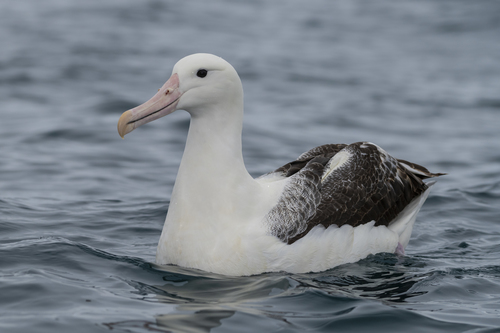
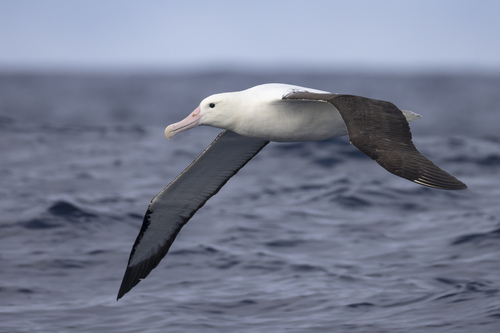
Diomedea sanfordi, commonly known as the northern royal albatross, typically reaches about 115 cm (45 in) in height, weighs 6.2 to 8.2 kg (14–18 lb), and has a wingspan of 270 to 305 cm (106–120 in). Juvenile northern royal albatrosses have white heads, necks, upper mantles, rumps, and underparts, with dark speckling on the crown and rump. Their lower mantles and backs are white with more black speckling than the crown, they have dark black-brown upper wings with white flecks on their coverts. Their tails and underwings are white with black-brown tips, and there is a black band behind the leading edge of the wings between the carpal joint and the wing tip. As the birds age, their heads, backs, rumps, tails, and scapular regions become whiter. Individuals of all ages have a pink bill with a black cutting edge on the upper mandible, plus pale pink legs. At sea, the northern royal albatross can be told apart from the southern royal albatross by its all-dark upper wing plumage, while the southern royal albatross has large areas of white on its upper wings; the two species also differ in behavior. Northern royal albatrosses nest on the Chatham Islands (Forty-fours Island, Big Sister Island, and Little Sister Island), Enderby Island in the Auckland Islands, and Taiaroa Head on the Otago Peninsula of New Zealand. The colony at Taiaroa Head is the only albatross colony located on a human-inhabited mainland in the Southern Hemisphere. When not breeding, northern royal albatrosses make circumpolar flights across the southern oceans, and they particularly favor the Humboldt Current and the Patagonian Shelf. Northern royal albatrosses perform very extensive mutual or group displays, which sometimes take place in the air or on the water. Once a pair bond is formed, the displays become less elaborate. Breeding does not begin until the birds are eight years old. They nest biennially, building nests on flat summits of the islands they frequent, preferring sites in grass or herbs. Their nest is a low mound made of vegetation, mud, and feathers. A single egg is laid in October or November, and both parents share incubation, which takes around 80 days total. The chick is brooded for one month, and is ready to fledge after approximately 240 days. The breeding colonies of the northern royal albatross are denser than colonies of any other species of great albatross.