About Diomedea exulans Linnaeus, 1758
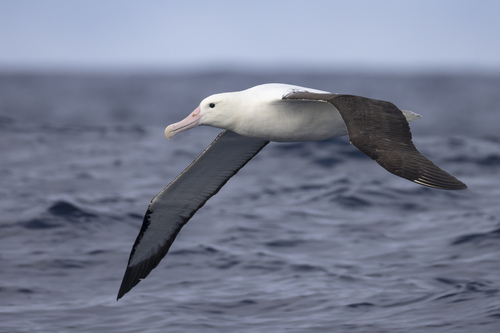
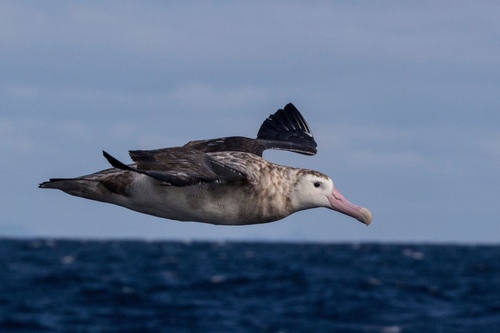
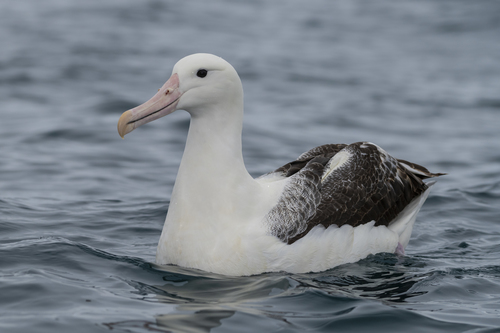
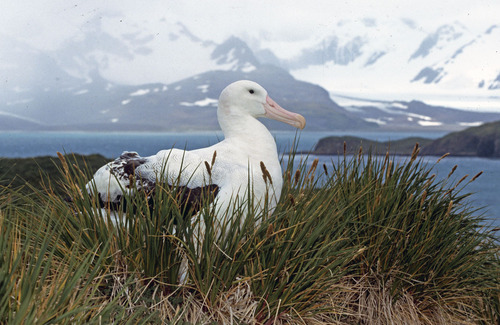
This species, Diomedea exulans Linnaeus, 1758, commonly known as the snowy albatross, has plumage that changes color with age. Juveniles start out chocolate brown, and become progressively whiter as they age. Adult snowy albatrosses have white bodies and black-and-white wings. Males have whiter wings than females, with only the wing tips and trailing edges colored black. Among the species in the wandering albatross species complex, the snowy albatross is the whitest. Other species in the complex have much more brown and black coloring on their wings and bodies, and closely resemble immature wandering albatrosses. The snowy albatross has a large pink bill, and its feet are also pink. It has a salt gland located above the nasal passage, which helps desalinate the bird's body to handle the large amount of ocean water it drinks. The bird excretes a high-saline solution through its nose, which is the probable cause of the pink-yellow stains seen on the necks of some individuals. Snowy albatrosses breed on South Georgia Island, the Crozet Islands, the Kerguelen Islands, the Prince Edward Islands, and Macquarie Island. They can be seen feeding year-round off the Kaikōura Peninsula on the east coast of New Zealand's South Island. Their range covers all southern oceans between 28° and 60° latitude. Some individual snowy albatrosses have been recorded circumnavigating the Southern Ocean three times in a single year, covering more than 120,000 km (75,000 mi). Snowy albatrosses spend most of their life in flight, and only land to breed and feed. While annual travel distances are hard to measure, one banded bird was recorded traveling 6,000 km (3,700 mi) in twelve days. The snowy albatross is a monogamous species that mates for life, and breeds once every other year. During the breeding season, they form loose colonies on isolated Southern Ocean island groups. During courtship, birds spread their wings, wave their heads, rap their bills together, and bray. Individuals from this species complex perform a wide range of displays, producing vocalizations from screams and whistles to grunts along with bill clapping. Females lay a single white egg with a few small spots that measures approximately 10 cm (3.9 in) long. Egg laying occurs between 10 December and 5 January. Nests are large bowl-shaped structures built from grassy vegetation and soil peat, with a 1-meter wide base and a half-meter wide apex. Incubation lasts approximately 11 weeks, and both parents share incubation duties. This 11-week incubation period is among the longest recorded for any bird. During the early stages of chick development, the parents take turns sitting on the nest while the other searches for food. Later in development, both adults leave to search for food and return to feed the chick at irregular intervals. Researchers originally assumed that chicks went without food through the entire winter after a 12 to 16 week weaning period. Later studies disproved this, finding that chicks feed during this winter period. Adolescent birds return to the breeding colony within six years after fledging, but do not begin breeding until they are 11 to 15 years old. Approximately 31.5% of fledglings survive to adulthood. Snowy albatrosses can live for over 50 years.