About Diogenes pugilator (Roux, 1828)
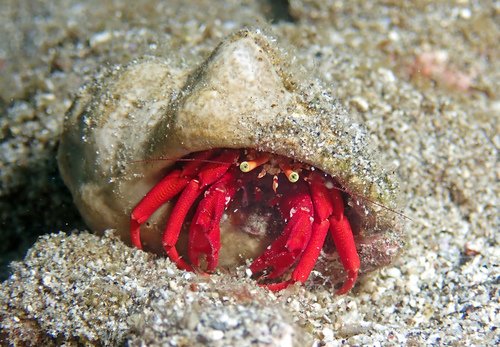
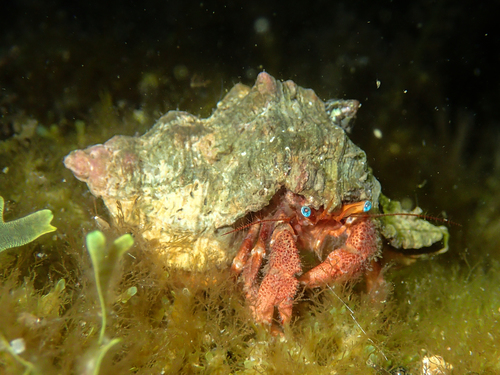
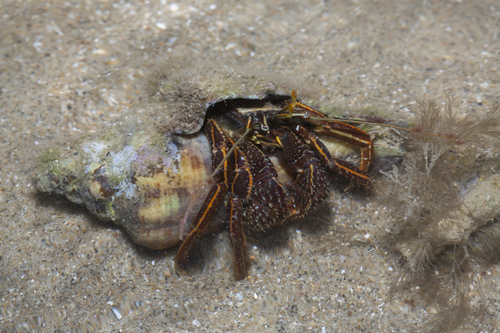
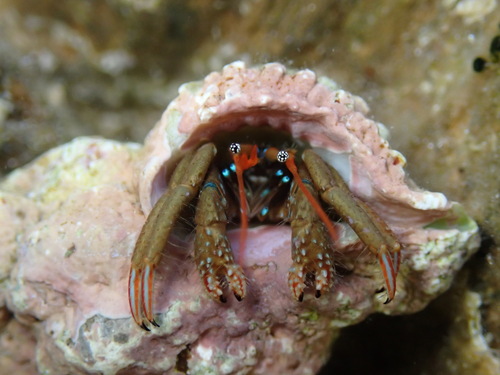
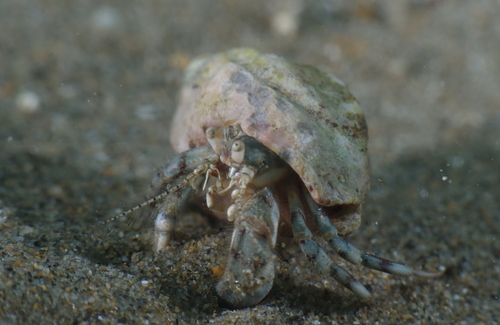
Like other hermit crabs, Diogenes pugilator hides its soft abdomen inside an empty gastropod mollusc shell. Its abdomen is twisted to match the shape of the shell it occupies. A hard carapace protects the front part of the crab, reaching a maximum length of 11 mm (0.43 in). The carapace is squarish, bears triangular projections along its front edge, and is covered in hairs on its two front corners. The crab's eyes sit on stalks that are roughly half as long as the carapace is wide. Its left claw (chela) is much larger than its right claw, and both claws are covered in short hairs. The claws and other walking legs can be pulled fully back into the entrance of the occupied shell. Diogenes pugilator is native to the temperate and subtropical eastern Atlantic Ocean. Its range extends south from the southern North Sea to Angola, and also includes the Mediterranean Sea, the Black Sea, and the Red Sea. Its northern limit was once believed to be Swansea in South Wales, but the species has since been found as far north as Anglesey, along the coasts of southwestern Ireland. This species lives on soft substrates, ranging from shallow subtidal areas down to depths of 1,800 m (5,906 ft), though it is most abundant in shallow water. This small hermit crab most often occupies empty shells from the netted dog whelk Tritia reticulata. These crabs are commonly found on gently sloping beaches made of medium to fine-grained sand, where waves wash onto the shore. When exposed, they quickly bury themselves in the sand, using their enlarged left claw to stay anchored in wet sand and reduce how much they are rolled around by moving waves. Near Cádiz in southern Spain, three hermit crab species share habitat: Diogenes pugilator, Paguristes eremita and Pagurus forbesii. Of these three, Paguristes eremita is the largest and strongest, and it uses the most robust gastropod shells with the widest apertures. Diogenes pugilator is the most numerous of the three, but it generally does not use shells from the most common local gastropod Turritella turbona, which Pagurus forbesii prefers instead. Diogenes pugilator instead uses shells from the less common Tritia reticulata, even when the crab's carapace is large enough that it extends past the shell's aperture.