About Dinopium benghalense (Linnaeus, 1758)
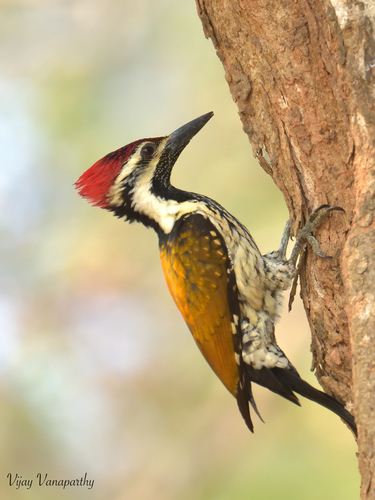
The black-rumped flameback, Dinopium benghalense, is a large woodpecker measuring 26–29 cm in length. It has the characteristic shape of a woodpecker, with distinctive golden yellow wing coverts. Unlike the greater flameback, this species has a black rump rather than a red rump, and it lacks dark moustachial stripes. Its underparts are white with dark chevron-shaped markings. A black throat finely marked with white immediately distinguishes this species from other golden-backed woodpeckers in the Indian region. The head is whitish, with a black nape and black throat, and it has a greyish eye patch. Adult males have a red crown and crest. Females have a black forecrown spotted with white, and only the rear crest is red. Young birds resemble females but have duller coloration. Like other woodpeckers, the black-rumped flameback has a straight, pointed bill, a stiff tail that provides support against tree trunks, and zygodactyl feet, with two toes pointing forward and two pointing backward. Its long tongue can be extended quickly forward to capture insects. This is the only golden-backed woodpecker that has both a black throat and a black rump. Leucistic individuals of this species have been recorded. Two male specimens from the northern Western Ghats were observed to have red-tipped feathers in the malar region that almost form a malar stripe. One female specimen from Lucknow was noted to have an abnormal downcurved bill similar to that of a hoopoe. This flameback occurs mainly on plains, ranging up to an elevation of around 1200 m. Its distribution covers Pakistan, India south of the Himalayas, extending east to the western Assam valley and Meghalaya, Bangladesh, and Sri Lanka. It is associated with open forest and cultivation areas, and is often found in urban areas with wooded avenues. It is somewhat rare in the Kutch and desert region of Rajasthan. Black-rumped flamebacks are most often seen in pairs or small groups, and will sometimes join mixed-species foraging flocks. They forage from ground level up to the forest canopy. They feed primarily on insects, especially beetle larvae taken from under bark, and will also visit termite mounds and sometimes feed on nectar. As they hop around branches, they often hide themselves from potential predators. They adapt well to habitats modified by humans, making use of artificial structures, fallen fruit, and even food scraps. The breeding season changes with local weather, falling between February and July. The species frequently drums during the breeding season. Black-rumped flamebacks usually excavate their own nest holes, which have a horizontal entrance leading down into a cavity. Sometimes they will take over nest holes made by other birds. Nests have also been recorded in mud embankments. Eggs are laid inside the unlined cavity. The typical clutch size is three eggs, which are elongate and glossy white. Eggs hatch after approximately 11 days of incubation, and chicks leave the nest around 20 days after hatching.