About Dimocarpus longan Lour.
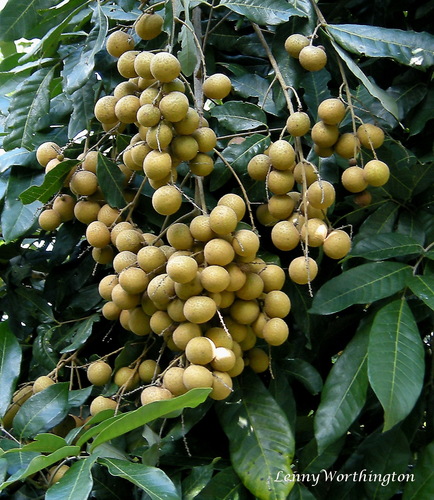
Dimocarpus longan Lour., the longan tree, varies in maximum height based on climate and soil type, growing to over 30 metres (100 ft) tall. It most commonly reaches 9–12 m (30–40 ft) in height, and has a round crown. Its trunk can grow up to 80 cm (2+1⁄2 ft) thick, and is covered in corky bark. Longan branches are long, thick, and typically drooping. Leaves are alternate, pinnately compound, with 6 to 9 pairs of oblong, blunt-tipped leaflets per leaf. Individual leaflets are usually 10–20 centimetres (4–8 in) long and 5 cm (2 in) wide. The upper leaf surface is wavy, colored a dark glossy green. Longan trees produce light-yellow inflorescences called panicles at the ends of branches. These panicles are 10–46 cm (4–18 in) long and widely branched. Small individual flowers on the panicle have 5 to 6 sepals and brownish-yellow petals, plus a two-lobed pistil and 8 stamens. Three flower types are spread across the panicle: functionally male staminate, functionally female pistillate, and hermaphroditic. Flowering occurs in a sequential progression. Fruits are spherical, about 2.5 cm (1 in) wide, and hang in drooping clusters. The fruit's outer shell is tan, thin, and leathery with tiny fine hairs. When the shell is firm, it can be squeezed to remove the shell, similar to cracking a sunflower seed. The edible inner flesh is translucent, with a musky, sweet flavor compared to that of lychee fruit. Each fruit contains one large, round, hard black seed with a circular white spot at its base. This spot gives the fruit the appearance of an eye; the seed has a distinct lacquered look. The longan tree is somewhat sensitive to frost. It prefers temperatures that do not usually drop below 4.5 °C (40 °F), but can survive brief temperature drops to approximately −2 °C (28 °F). It grows best in sandy soil with mild acidity and moderate organic matter content. Longan trees usually produce fruit slightly later than lychee trees. Longan is commonly found across most of Asia, primarily in mainland China, Taiwan, Vietnam, and Thailand. China is the world's main longan-producing country, producing around 1.9 million metric tons (2.1 million short tons) of longan between 2015 and 2017. This production accounts for 70% of the world's total longan output, and more than 50% of the world's area planted to longan. Vietnam produced around 500 thousand metric tons (550 thousand short tons) and Thailand produced around 980 thousand metric tons (1,080 thousand short tons) in the same period. Like Vietnam, Thailand's economy relies heavily on cultivation and export of both longan and lychee. Rising global longan production reflects growing recent interest in exotic fruits in other regions of the world, though most demand for longan outside Asia comes from Asian communities in North America, Europe, and Australia. Today, commercial longan crops are cultivated in southern China, Taiwan, northern Thailand, Malaysia, Indonesia, Cambodia, Laos, Vietnam, India, Sri Lanka, the Philippines, Bangladesh, Mauritius, the United States, and Australia.